Audience Targeting
Part of Paid social audience targeting
Checking whether a lookalike source represents valuable customers
Audit a lookalike source for confirmed customer value, recency, geography and platform eligibility before using it for acquisition.
Judge a lookalike source by the customers in it, not by the audience a platform builds. Define ‘valuable’ from business records, then check the source’s composition and platform eligibility. A large file of leads or low-value orders may poorly represent the customers the business wants to acquire.
Define value for this acquisition goal
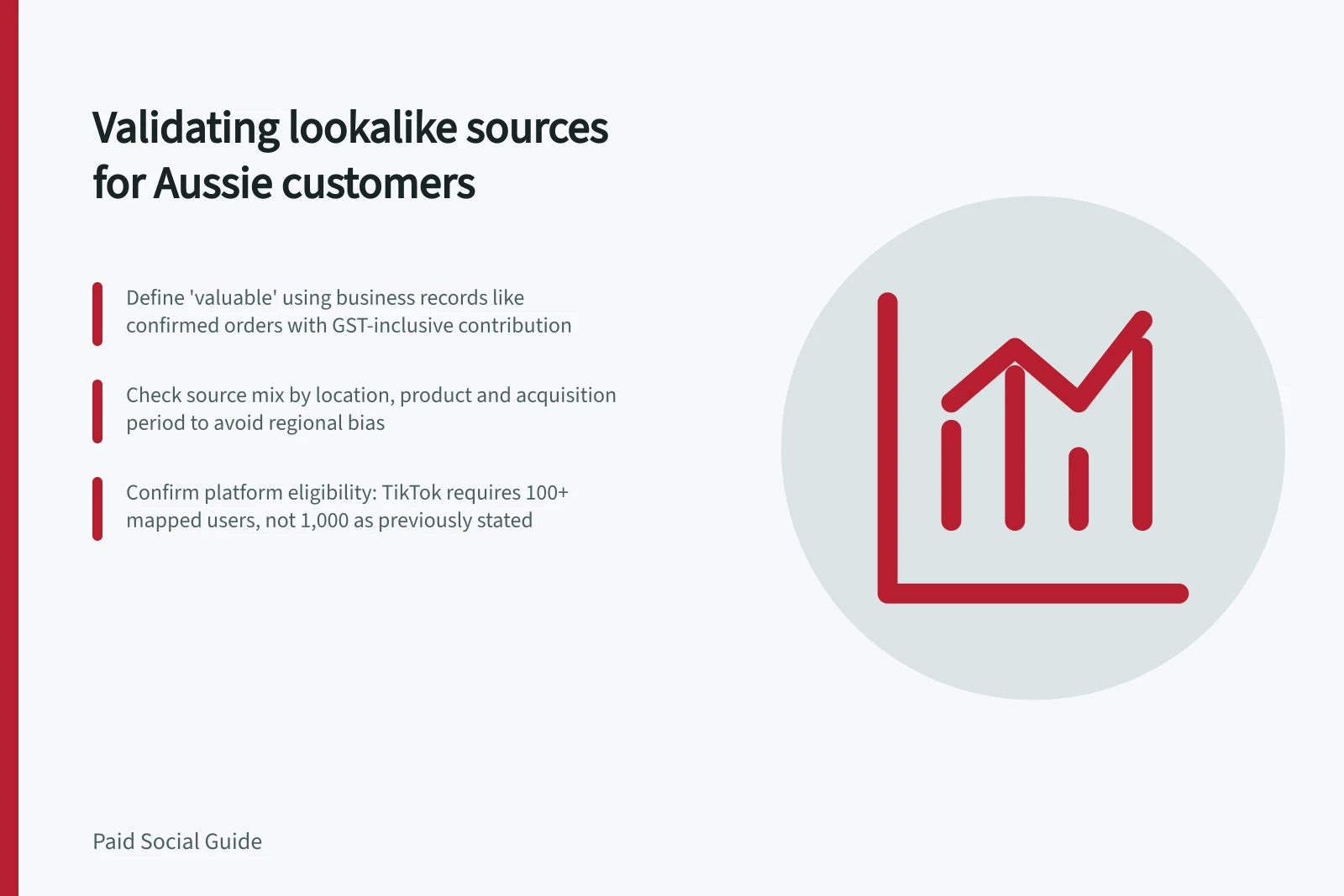
Choose a measure fitted to the offer. For a retailer, that might mean confirmed orders with acceptable contribution after relevant product and fulfilment costs. For a service business, it might mean suitable enquiries that became paying customers. Platform-attributed revenue alone cannot define customer value for the business.
Write the inclusion rule in ordinary language. For example: customers in serviceable Australian locations who bought an eligible product, whose orders were not cancelled and whose records fall within a relevant period. Check whether a few repeat buyers or one promotion dominate the source when the aim is to acquire a broader group of worthwhile first-time customers.
Audit the records
Compare the proposed source with the system of record. Remove duplicate identities and records that do not meet the rule. Inspect the mix by product, location, acquisition period and customer outcome. If one region supplies most records, decide whether that concentration reflects the market the business can now serve.
Source question / Why it matters
- Confirmed customers or only leads?
- Similarity to form submitters need not favour suitable customers.
- Current and serviceable?
- Old offers or unavailable regions can misrepresent the present market.
- Does a small group dominate value?
- An average may hide many lower-value records.
- Is the source usable?
- Business approval and platform eligibility both need checking.
Check whether missing, stale or conflicting fields could change whether a record meets the inclusion rule. Do not add unsuitable records merely to reach a minimum. If the desired customer cohort is too small, record the limitation and consider another acquisition approach.
Check the platform's source rules
TikTok builds a lookalike from a Custom Audience. Its builder offers Omit and Contain choices for the source: Omit leaves that source audience out of the lookalike, while Contain includes it. Omit fits a new-person acquisition aim more clearly, subject to any other customer exclusions the campaign needs.
TikTok also offers Narrow, Balanced and Broad sizes, which change the reach and similarity trade-off; none guarantees valuable customers.
TikTok’s published help pages conflict on the source minimum: its overview says 1,000, while its FAQ says 100 mapped users. Confirm eligibility in the current builder rather than planning around either figure alone.
LinkedIn’s help page states that lookalike audiences have been discontinued. Do not transfer TikTok’s setup assumptions to LinkedIn; check LinkedIn’s current product guidance if it is the chosen platform.
Decide what would validate the source
Record the cohort rule, source date, platform audience, offer and business outcome before launch. Check that the audience becomes available and that the intended location and source-containment choice are applied. Later, compare confirmed new-customer outcomes with the business’s value definition. Similarity alone does not establish profitable or incremental acquisition.
For Australian customer records and website activity, have the privacy owner assess the proposed data use against applicable privacy obligations, including the OAIC’s guidance on tracking pixels where relevant.