Audience Targeting
Part of Scaling paid social campaigns
Assessing whether a new region has enough demand
Screen an Australian region using fulfilment, business records, population, search interest and platform estimates before a bounded paid social trial.
A new region may merit a paid social trial when the business can fulfil its offer there, plausible eligible customers exist, and a bounded campaign can inform the next decision. Screen one candidate region at a time: population, search interest and platform audience estimates can help assess plausibility. None establishes how many people will buy this particular offer.
Define the serviceable area
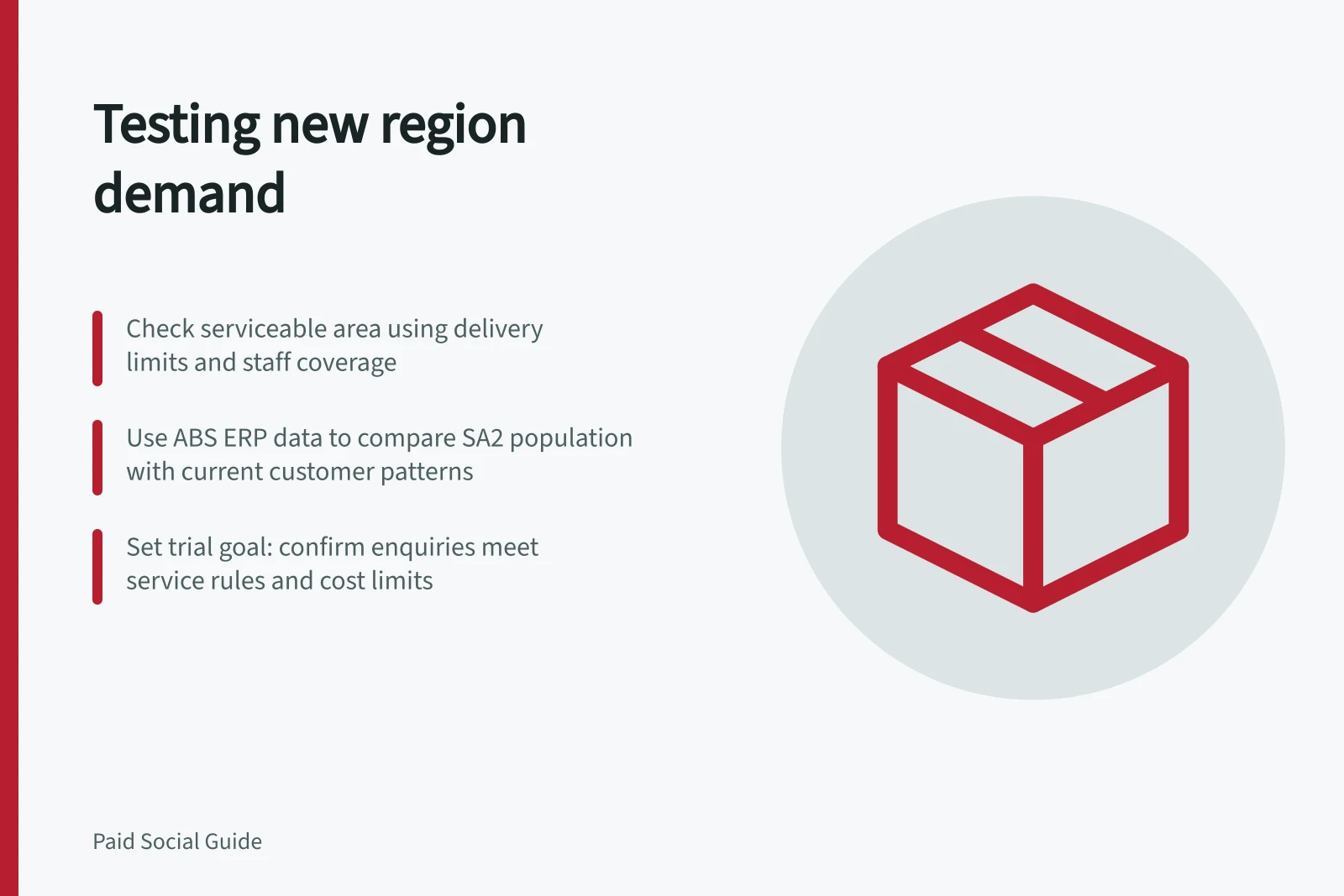
Start with the actual delivery, appointment or service boundary. Check costs, lead times, stock and staff coverage. List the locations the business serves, then compare them with those available in the ad account; the boundaries may differ.
For TikTok Ads Manager location options, use its About location targeting guidance, last updated August 2025. It says options vary by country or region, delivery and accuracy are not guaranteed, and location exclusions are unsupported.
Select the locations the account permits, then check received orders or enquiries against the business's service rule. If the new region needs separate approval or reporting, choose a campaign setup that can preserve that boundary.
Look for several demand signals
Review existing orders shipped nearby, eligible enquiries previously declined, customer questions, and visits with a reliably known location. Record how many support a pattern and whether the offer that generated them is still current.
Use the ABS Regional population, 2024–25 financial year release to compare a candidate SA2 with its service area. It defines population as Estimated Resident Population (ERP), uses SA2 for “area” and GCCSA for capital cities, and covers the 2024–25 financial year. Regional Australia grew by 94,700 (1.1%) in 2024–25, but residents are not prospective buyers or social-platform users.
Treat search-interest views as clues to check against current customer records, not buyer counts. Where the ad account provides a forecast, use the intended objective and targeting as a plausibility check against the service boundary and business records; estimates do not establish orders, fulfilment or margin.
Key Demand Signals for New Region Assessment
- Regional Population Growth (2024–25)
- 94,700 (1.1%)
- TikTok Location Targeting Accuracy
- Not guaranteed
- Google Trends Search Interest Use
- Clue, not buyer count
Decide whether to trial the region
Write down the question the trial must answer, such as whether enquiries meet a stated service rule and whether their cost fits the business's limit. Use a current offer, clear local eligibility and a destination that serves the area. Set an affordable media ceiling and review date. Include extra delivery cost or capacity limits when assessing orders.
Make the pre-trial decision explicit: go only if the region is serviceable, current business evidence supports a plausible offer, and the business can state what suitable outcome and cost would justify the test. Otherwise, record no-go or defer; population, search interest or audience estimates alone do not establish plausible buyers.
At review, show spend, delivery, suitable enquiries or confirmed orders, and reasons records were unsuitable. Sparse delivery does not prove that no demand exists; it may reflect targeting, settings or the affordable trial limit.
Interest without serviceable outcomes may call for a clearer offer or a different region. Expand only when observed business outcomes justify another approved step, with small-sample uncertainty visible.