Audience Targeting
Paid social audience targeting
Choose paid social audiences from eligibility, reliable signals and business outcomes. Understand broad, interest, customer and similar audiences and their limits.
Choose a paid social audience by defining who can use the offer, what the platform can identify and what each setting will help you decide. Start with genuine eligibility limits, such as service location. Add interests or customer data when they serve a clear purpose. A narrower audience is not automatically a better one.
Start with eligibility
Before opening the campaign builder, write down the people the business can serve. An Australian service advertiser may need to limit delivery to its service area. A retailer may need different locations for products with different delivery limits. Check the locations available in the chosen platform and account.
Keep business eligibility separate from platform signals. An interest label does not prove purchase intent. A website event records an observed action, not why it happened. An uploaded customer list represents records the platform could match, not every customer.
| Audience approach | Useful question | Main limit |
|---|---|---|
| Broad eligible audience | Can the offer speak clearly to people across the serviceable market? | Delivery may reach people with little interest. |
| Interest audience | Does a specific topic give us a useful acquisition hypothesis? | Interests are inferred signals. |
| Customer or activity audience | Do we have a relevant, permitted record of prior contact or action? | Data quality, matching and size limit coverage. |
| Lookalike or similar audience | Does the source represent customers we want more of? | Similarity does not establish customer value. |
Understand how targeting controls combine
In TikTok Ads Manager, targeting is configured at ad group level and can include demographics, audience targeting, advanced targeting and device type. Available location options vary by market, so confirm the controls offered in the account can represent the service area before relying on them.
TikTok combines selections within one dimension using OR logic, but combines selections across dimensions using AND logic. Selecting two interests can include people matching either one; adding an age range means people must also meet that age criterion. For age-restricted offers, or content that may not suit younger users, consider the available age-targeting options and relevant interest categories.
Give each setting a reason
Broad targeting can suit an offer with a wide eligible market and no defensible interest list. An interest audience can test a specific proposition. Keep essential location and eligibility rules in either approach.
On TikTok, interests reflect longer-term interests and content interactions. In its upgraded Smart+ experience, some audience inputs are suggestions for automatic targeting, while custom targeting provides manual choices. Check which role a setting has in the campaign being built.
TikTok lists customer files and website activity among its Custom Audience sources. It requires 1,000 matched users before a Custom Audience can be used in an ad group.
TikTok Custom Audience Requirements and Limits
- Minimum matched users required
- 1,000
- Lookalike audience creation time
- 24–48 hours
- Maximum lookalike groups per source
- 400
Use interest reporting as a learning signal
A selected interest does not necessarily describe everything known about a person. TikTok says a user can have several associated interests. If someone converts after an ad was targeted to Games, the report may record other interests associated with that user as well. TikTok states that the conversion is counted once for billing.
Review reported interests for patterns, including interests that were not selected. TikTok identifies performance by interest as a way to learn about an audience. It says adding an interest associated with a large share of conversions can help reach more potential users who convert. Treat this as a signal to assess against the business result, not proof that the interest caused the conversion.
Pros and Cons of Interest-Based Targeting on TikTok
- Pros
- Helps test acquisition hypotheses; can reveal unexpected conversion patterns
- Cons
- Interests are inferred signals; not proof of purchase intent or relevance
Check which customer signals are available
TikTok Custom Audiences can be created from customer files, website traffic, app activity, TikTok engagement, lead generation, a business account, shop activity or an audience activation partner. These sources can represent different kinds of contact, so choose one that matches the question the campaign is meant to answer.
TikTok lists Custom Audiences as usable for retargeting leads or past engagers, excluding recent customers to optimise spend, and creating lookalike audiences. The available-audience estimate at campaign setup accounts for factors including users' opt-in status, age and location. It can provide a more realistic indication of campaign reach than the stored audience size alone.
Decide who should be left out
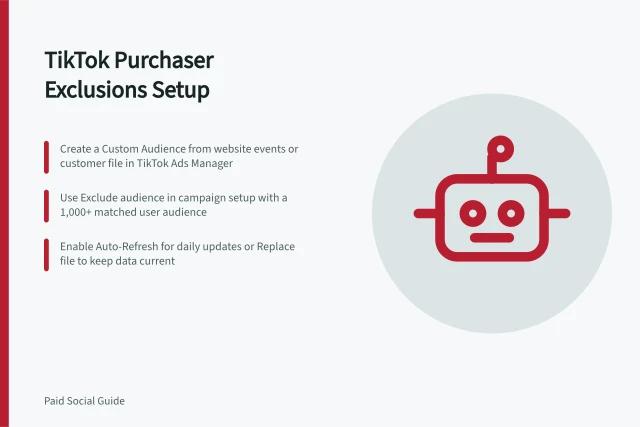
An observed purchaser may need to be excluded from an acquisition message. The practical task is to create an eligible audience, place it in the campaign's exclusion control and keep its source current.
TikTok lists Custom Audiences as a way to exclude recent customers to optimise campaign spend. An exclusion can only cover purchasers represented in the source audience, so check that it reflects the customer records relevant to the campaign.
Treat similarity as a source-data question
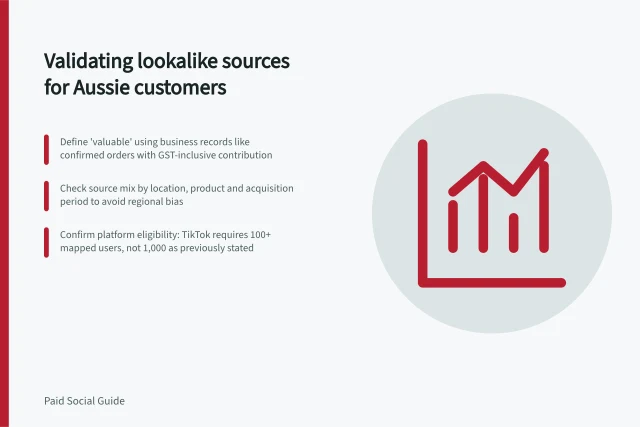
A source of all leads may resemble people who submit forms, including people the business cannot serve. Review a proposed source's dates, geography and customer outcomes before using it to find similar people.
TikTok builds lookalikes from Custom Audiences and offers a choice to omit or contain the source. LinkedIn says lookalike audiences have been discontinued.
Allow for lookalike processing
TikTok says lookalike audiences are usually created within 24–48 hours. While one is being created, it appears as unavailable in Audience Manager, so check its status before planning delivery around it. TikTok allows up to 400 lookalike audience groups from the same Custom Audience source.
Creating a Lookalike Audience on TikTok
- Select a Custom Audience sourceUse customer files, website traffic, app activity or other verified data
- Wait for processing24–48 hours; audience appears as unavailable during creation
- Use in campaignAvailable once status changes to 'Active' in Audience Manager
Review the business result
Record the offer, eligible locations, audience settings, creative, destination and review period. Compare platform-reported actions with confirmed orders or suitable enquiries. If a narrow audience delivers little, inspect its reach and settings. If broad delivery produces unsuitable responses, inspect the message and destination as well as targeting.
For an Australian organisation using a third-party website pixel, have the privacy owner review the proposed data flow and applicable privacy obligations.
In this guide
- Broad targeting versus interest-based audiencesCompare broad and interest-based paid social audiences by hypothesis, platform controls and useful business outcomes, with Australian advertiser examples.
- Configuring TikTok purchaser exclusions and audience refreshBuild a TikTok purchaser audience from website events or a customer file, apply it under Exclude audience, maintain refresh and check size and assignment.
- Checking whether a lookalike source represents valuable customersAudit a lookalike source for confirmed customer value, recency, geography and platform eligibility before using it for acquisition.