Account Reviews
Part of Paid social measurement
Reading paid social performance alongside contribution margin
Calculate what confirmed sales leave after relevant variable costs and allocated ad spend, with attribution limits visible.
Read paid social results beside the contribution confirmed sales leave after relevant variable costs. Revenue and return on ad spend omit those costs. A campaign can report substantial purchase value while the resulting orders leave too little to cover advertising and fixed costs.
Set the calculation boundary
Contribution before advertising is eligible sales revenue less costs that vary with those sales. For a retailer, those costs may include product cost, packing, fulfilment, payment fees and an allowance for expected returns where applicable. For a service business, they may include delivery labour and materials. Write down the costs included and apply the same rule across the orders being compared.
Use a consistent tax and currency basis. Include actual discounts and the product mix sold, rather than a full-price catalogue average. Mark results provisional where refunds or costs remain open.
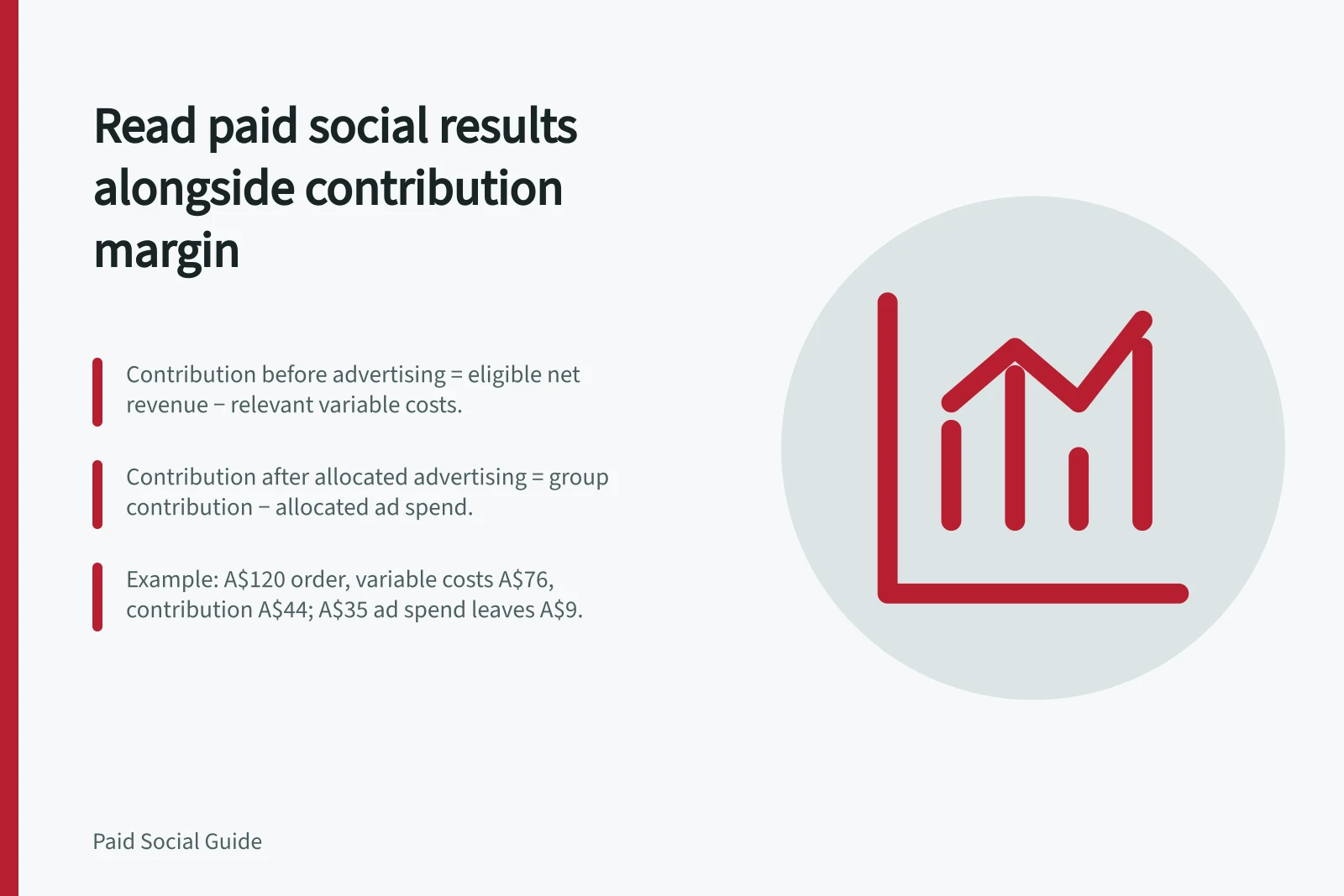
Contribution before advertising = eligible net revenue − relevant variable costs.
For a defined group of orders, add their contribution and show the ad spend allocated to that group separately. Contribution after allocated advertising = group contribution before advertising − allocated ad spend. State how spend was allocated.
This is a management comparison, not a measure of profit caused by the advertising. Fixed costs still need coverage.
Build the contribution comparison
- Define eligible net revenueUse a consistent tax and currency basis, including actual discounts and product mix.
- Subtract relevant variable costsProduct cost, packing, fulfilment, payment fees and expected returns where applicable. Contribution before advertising = eligible net revenue − relevant variable costs.
- Add contribution for the order groupFor a defined group of orders, sum their contribution before advertising.
- Allocate ad spend and state the methodContribution after allocated advertising = group contribution before advertising − allocated ad spend.
- Mark provisional resultsWhere refunds or costs remain open, treat the result as provisional.
Check the arithmetic and its limits
Consider a hypothetical Australian retailer with one eligible order worth A$120 on a consistent revenue basis. Product cost is A$52, packing and fulfilment A$14, payment cost A$4 and the expected return allowance A$6. Contribution before advertising is A$44. If the business allocates A$35 of campaign spend to this order under a stated method, the illustrative remainder is A$9 before fixed costs.
Those amounts are an arithmetic example, not a benchmark or observed campaign result. An allocation based on platform-attributed purchases inherits that attribution count’s limits. A first-party order population gives another view, but neither allocation proves incremental profit.
| Figure | What it shows | What it leaves out |
|---|---|---|
| Platform-reported purchase value | Value attributed under platform settings | Final order status and variable costs |
| Confirmed net sales | Value of eligible business orders | Variable costs and ad causation |
| Contribution before advertising | Value left after specified variable costs | Advertising and fixed costs |
| Contribution after allocated advertising | Value left after a stated spend allocation | Fixed costs and uncertainty about causation |
Four views of paid social performance and their limits
- Platform-reported purchase valueShows value attributed under platform settings. Leaves out final order status and variable costs.
- Confirmed net salesShows value of eligible business orders. Leaves out variable costs and ad causation.
- Contribution before advertisingShows value left after specified variable costs. Leaves out advertising and fixed costs.
- Contribution after allocated advertisingShows value left after a stated spend allocation. Leaves out fixed costs and uncertainty about causation.
Use the result for a decision
Separate products or offers with materially different prices, discounts, delivery costs or return patterns before relying on one average margin. Check the order count behind every ratio: a later refund or one different product can move a small group’s result substantially.
Set the minimum acceptable remainder with the business or finance owner, accounting for fixed costs, capacity and risk. There is no universal target in this calculation. If a larger spend decision depends on additional profit, use a suitable comparison design rather than attributed return on ad spend alone.
Use the result for a decision
- Separate materially different products or offersDo this before relying on one average margin.
- Check the order count behind every ratioA later refund or one different product can move a small group's result substantially.
- Set the minimum acceptable remainderAgree with the business or finance owner, accounting for fixed costs, capacity and risk.
- Use a suitable comparison design for larger spendIf the decision depends on additional profit, do not rely on attributed return on ad spend alone.