Account Reviews
Part of Scaling paid social campaigns
Deciding when to reduce spend instead of chasing volume
Use business value, fulfilment and measurement checks to decide when to reverse a paid social spend increase or pause affected promotion.
Reduce paid social spend when extra approved spend is unlikely to earn enough useful business value, or when the business cannot fulfil what its ads promise. More attributed conversions or a larger sales total do not settle that decision. Separate faults needing a prompt stop from economic results that need time to mature.
Stop a live fault promptly
Pause the affected promotion if it advertises an unavailable offer, sends people to a broken destination or spends beyond the business's approved limit. Confirm the resulting account status and spend. Correct an inaccurate live promise when found, without waiting for a routine performance review.
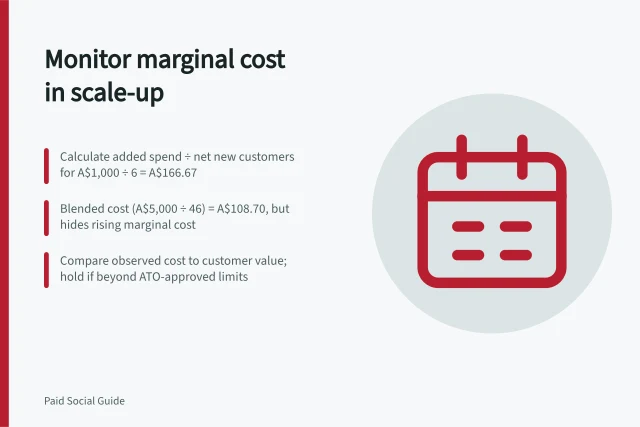
For an economic review, define the period and confirmed outcome: worthwhile orders, paying customers or suitable enquiries. Compare added spend with net additional outcomes and their contribution after relevant variable costs.
Later customers may cost more than the business can support, even as total volume rises. Check whether refunds, discounts, delivery costs or staffing needs changed the value of that volume.
| Finding | Decision to consider | Check |
|---|---|---|
| Spend exceeds business approval | Stop or lower affected spend | Actual budget level, cumulative spend and account status |
| The offer cannot be fulfilled as advertised | Pause affected promotion | Stock, service area, destination and revised claim |
| Mature added outcomes cost more than the business can support | Reverse the recent increase or reduce the relevant stream | Customer value, records and other changes |
| Platform conversions fall but business outcomes do not | Investigate measurement before an economic conclusion | Event source, attribution settings and reporting delay |
| Frequency rises while useful outcomes flatten | Investigate a bounded reduction | Audience, new reach, creative and other causes |
Rising frequency is a signal to investigate, not a universal threshold. A few outcomes in a small audience can make a short-term rate unstable.
Reduce the affected spend
Locate where the added spend went. If a new region produces unsuitable enquiries, examine that region's spend and eligibility message before cutting an established area.
If a new creative receives little delivery, its low outcome count does not justify cutting an unrelated ad. Under a shared budget, inspect allocation; TikTok says campaign budget optimisation may put most spend in one or two ad groups.
Choose the narrowest action that reliably addresses the problem: reverse a recent increase, lower an approved budget, pause an affected group or stop the campaign if the offer is not viable. Record the old and new limits, affected objects, owner and time.
Check the live account controls. TikTok's daily budget is an average per day, while its lifetime budget limits the scheduled total and may be spent unevenly. Neither description establishes a separate business approval control for every stream.
TikTok Budget Controls: Key Differences
- Daily Budget
- Average spend per day
- Lifetime Budget
- Scheduled total limit; may be spent unevenly
- Business Approval Control
- Not established separately for every stream
Verify and review
After the platform processes the change, confirm the intended ads' status and actual spend. At the agreed review point, compare confirmed outcomes and contribution with the cost saved.
Keep recent platform conversions provisional when later activity or processing can change their count. TikTok may credit view-through conversions; those are attributed results, not proof of sales caused by an impression.
Record the risk the business chose, the evidence still uncertain and what would justify restoring spend. A reduction may protect cash while an offer, page or measurement problem is repaired, but it can also forgo worthwhile customers. When additional sales caused by advertising are the deciding issue, use a suitable comparison rather than an attributed dashboard total.