Creative Testing
Part of Paid social creative planning
Turning a customer objection into an ad concept
Use a customer question to brief an ad concept with a supportable answer, suitable demonstration and clear next step.
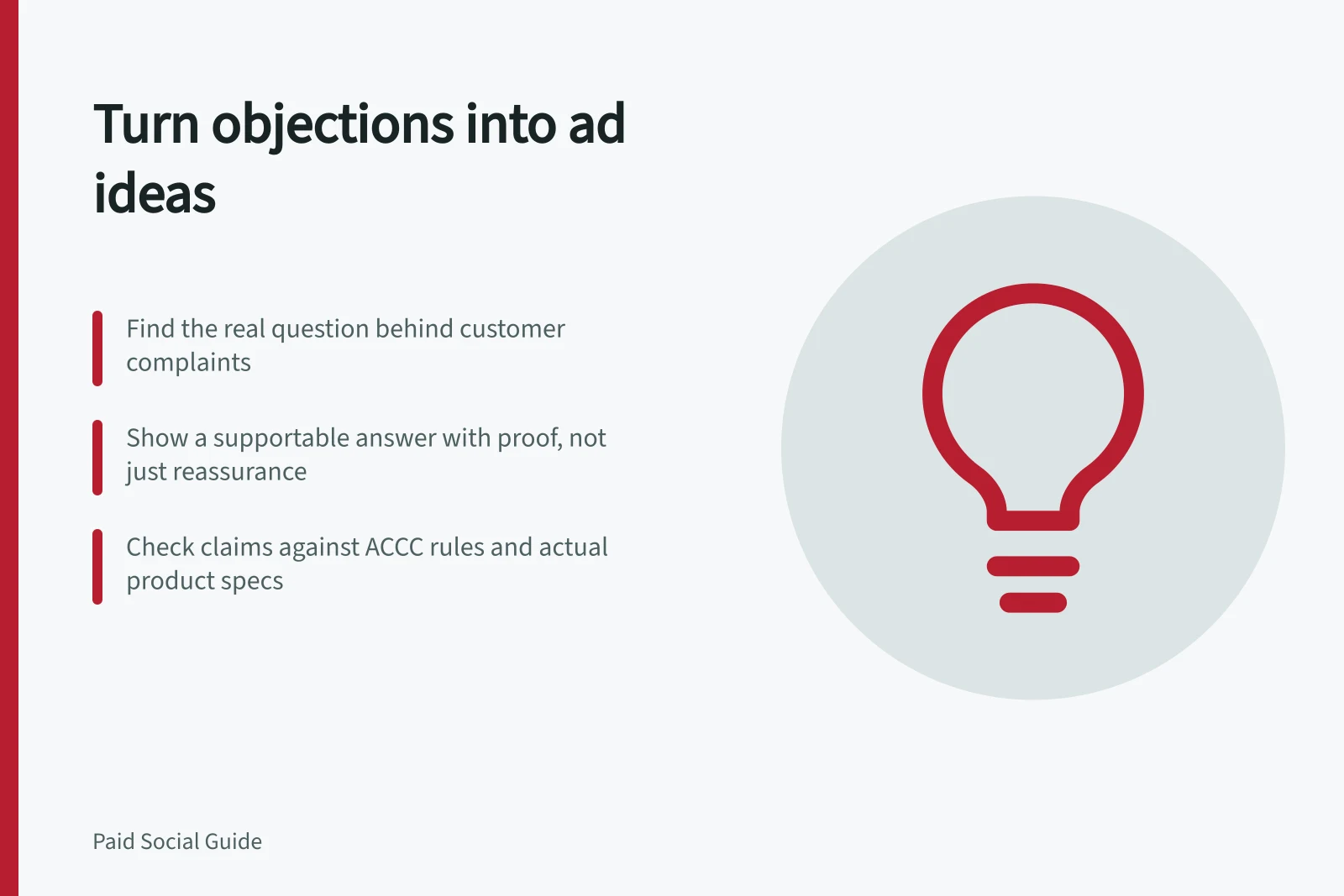
Turn a customer objection into an ad concept: find the question behind it, choose an answer the business can support, and show that answer in the ad. The objection supplies an angle; it does not justify a broader claim.
Find the question behind the wording
Collect questions from enquiries, sales notes, returns and product support. Remove personal details before sharing them in a creative brief. Group them by what a buyer is deciding: suitability, use, delivery, cost or post-purchase outcomes. Keep original wording in an internal note, but do not present one person's comment as a representative customer quote.
A customer asking “Will this fit in my car?” may need dimensions and a way to check compatibility. “Fits every car” answers a much broader question. First establish which dimensions or vehicles are covered, and where that information is recorded.
Choose a supportable answer
| Customer question | Possible creative response | Information to check |
|---|---|---|
| “Will it fit?” | Show the relevant measurement or selection step | Current dimensions and compatibility details |
| “Is setup difficult?” | Show the actual setup sequence | Current instructions and the model filmed |
| “What happens next?” | Explain the ordering or enquiry steps | Current process and service limits |
| “Why does it cost more?” | Explain included features without asserting superiority | Current specifications and inclusions |
This map proposes concepts, not verified product claims. A demonstration can answer a practical question when the camera shows the relevant step. A specification may suit an exact fit or capacity question. A process explanation may help more than a testimonial when the concern is what happens after an enquiry.
Write one concept
Write a short brief covering the customer question, the answer, what viewers will see or hear and the next action. For a hypothetical flat-pack storage product: “How is it assembled? Show the current model being assembled with the steps visible. Invite viewers to check dimensions and the full instructions.” This does not claim that assembly is quick or easy.
Open with a recognisable question, without implying private knowledge of the viewer. Show the answer and offer a matching next step. A size guide may be more useful than a checkout prompt when compatibility remains uncertain. TikTok's creative guidance recommends a hook, a product point and a clear call to action; use that sequence only where it helps answer the question.
Check what the concept promises
Read the visual, wording and destination together. Footage of one product variant should not quietly stand for the whole range. A customer review describes that person's experience, not a typical outcome. The ACCC says it can require businesses to back up claims they make about their products or services, and may investigate if a business misleads.
If the objection reveals a real limitation, state it plainly. If it reveals a missing specification, obtain it before making the claim. If the business cannot establish an answer, explain a verified next step instead of filling the gap with reassurance.
Give the producer the approved answer, evidence owner, exact product version and any condition that must appear. Ask someone unfamiliar with the brief to describe what the finished ad promises. Their reading can reveal unclear wording before submission.
Key facts from ACCC and TikTok guidelines
- ACCC investigation powerCan require businesses to back up claims about products or services.
- TikTok creative hook formulaHook + product point + clear CTA – use only when helpful for answering the objection.
- Online review authenticityA single review reflects one experience, not typical outcomes.