Creative Testing
Part of Paid social creative experiments
Comparing concepts before testing minor design changes
Define distinct ad messages, compare them on a useful outcome and decide when a smaller creative edit deserves its own test.
Compare different answers to a customer's question before polishing a colour, crop or opening frame. Decide which message deserves more development, judged on an outcome that matters to the business.
Define two concepts
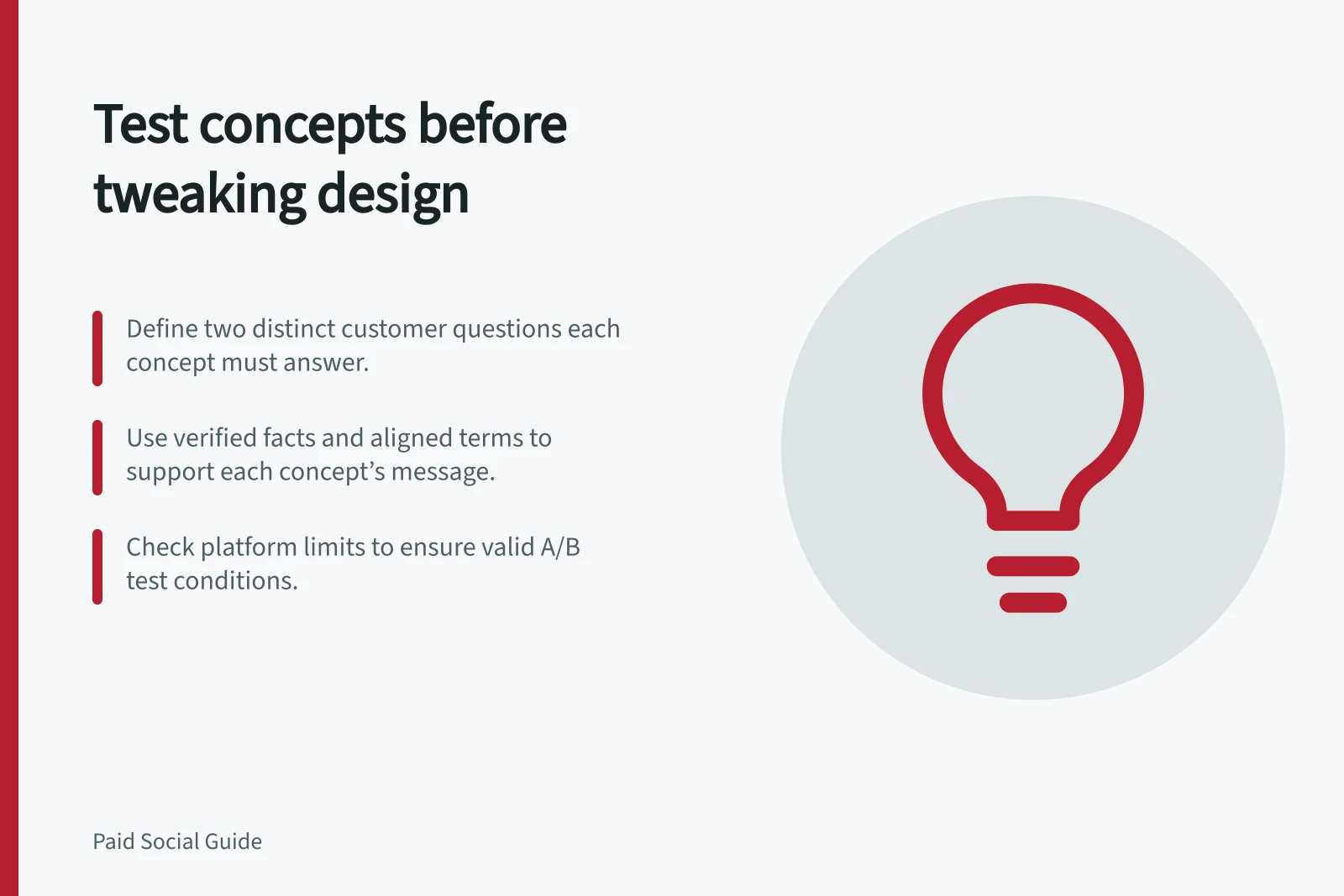
For a hypothetical storage product, one ad could show assembly; another could explain dimensions and fit. Both would advertise the same model under the same current terms. Each concept should answer a distinct question the business can address accurately.
Write each concept in one sentence: what will the customer learn, and what decision will that help them make? Identify the footage, specification or process record needed to support the answer. If the necessary fact is unverified, resolve it before using that concept.
A different message may need different footage and wording. Record those differences. Keep the offer, material conditions and next action aligned, so a new price or destination does not become the main reason for a different result.
Choose what would settle the decision
Define the result that would change the next creative brief. If suitable enquiries matter, set the suitability rule in business records before launch. A click measure can show initial interest, but it cannot establish that respondents were suitable customers.
Check whether the platform's controlled test can represent the proposed contrast. TikTok lists Creative and Creative Assets as split-test variables, permits one selected variable per test, and restricts Creative tests under campaign budget optimisation.
LinkedIn documents an ad-variable A/B test in Campaign Manager. Check what that test can vary before relying on it.
Two ordinary ads can screen ideas, but unequal delivery limits what their observed difference can show. Keep spend and impressions beside each result, and describe the finding accordingly.
Key Stats for Valid Concept Comparison
- TikTok Split Test Variables
- Creative and Creative Assets only
- Test Limitation
- One variable per test under campaign budget optimisation
- LinkedIn A/B Test Availability
- Yes, via Campaign Manager
- Required Condition for Valid Test
- Equal spend and impressions across variants
- Outcome Focus
- Qualified customer action, not just clicks
Brief and assess the concepts
Give both versions the same current product facts, material conditions and destination. Preview each intended placement so a cropped qualification does not distort the comparison. Record the approved asset and wording for each variant.
Brief field / Record
- Customer question
- What the buyer needs to decide
- Answer shown
- Demonstration, explanation or verified fact
- Shared terms
- Product, offer and essential conditions
- Distinct elements
- Footage and wording that express each concept
- Review measure
- Platform response and useful business outcome
When the comparison has enough relevant delivery to inform a decision, develop the better-supported concept. TikTok's Video Insights guidance suggests using video-interaction and key-frame patterns to generate ideas for hooks or topics.
Those patterns can suggest an edit; they do not show which frame caused an order. If neither concept produces useful action, inspect the offer and destination before testing a minor design change. If delivery is sparse, preserve that uncertainty rather than declaring a winner.