Account Reviews
Part of Social advertising policy and brand checks
Reviewing a social ad claim before submission
Check what a social ad promises, match each material claim to current evidence and decide whether to keep, narrow or hold the wording.
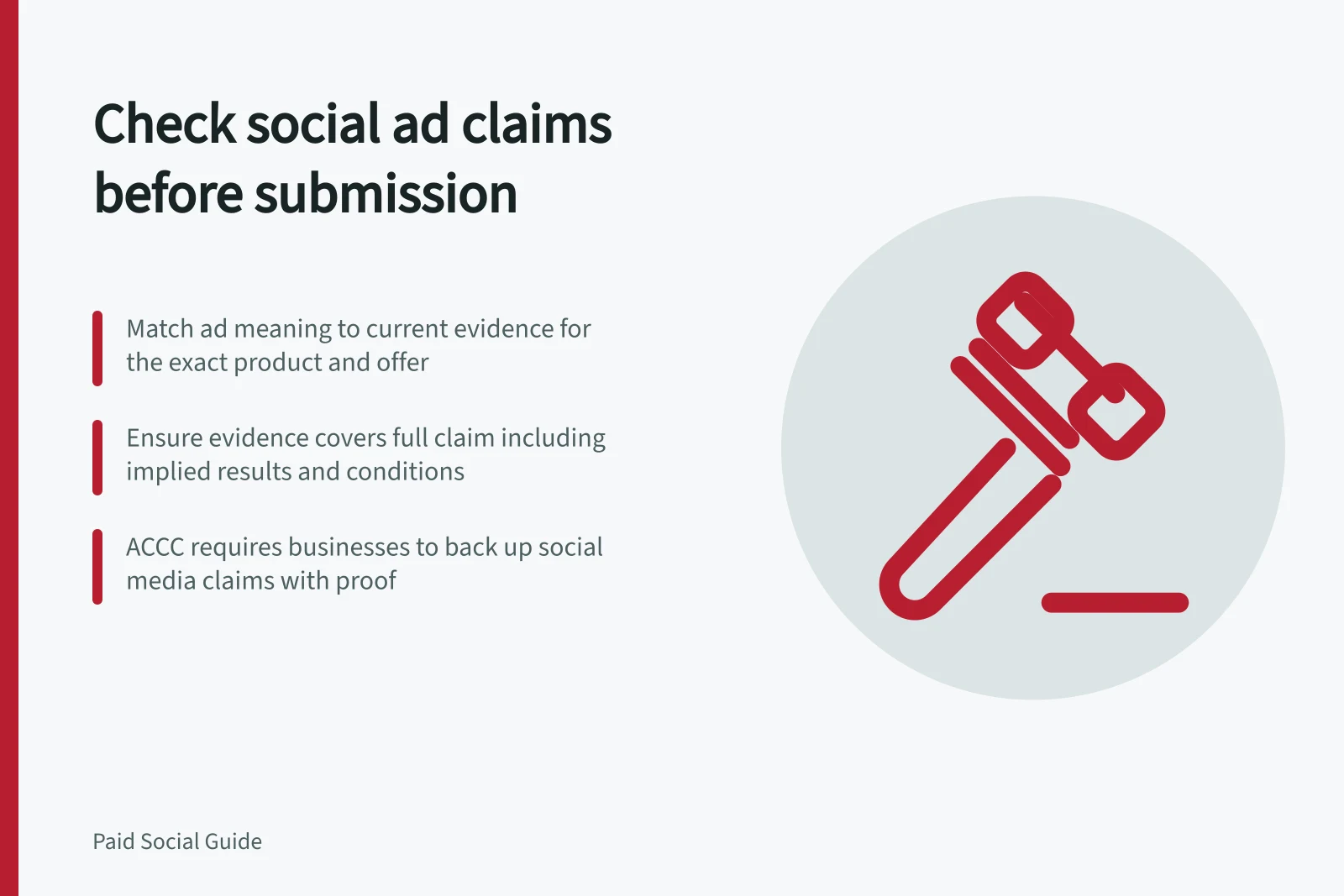
Before submitting a social ad, write down what its words and visuals would lead a viewer to believe. Match that meaning to current evidence for the exact product and offer. Keep a claim only when the evidence covers its full meaning, including implied results and conditions.
Extract claims from the finished ad
Review the image or video, spoken words, on-screen text, caption and call to action together. A demonstration or customer statement can imply a claim even when the headline is cautious. Read the destination alongside the ad for contradictions or material qualifications.
For each material claim, record the product version, audience and location, ordinary meaning, evidence owner and review date. Pay particular attention to price and savings, availability, delivery, performance, comparisons and future outcomes. The ACCC can require businesses to back up claims they make on social media.
ACCC Requirements for Social Media Advertising Claims
- Businesses must back up claims made on social mediaYes – ACCC enforces truth in advertising under Australian Consumer Law
- Customer testimonials require verificationMust be genuine and representative, not cherry-picked
Match evidence to the wording
Ask three questions for each claim:
- Is it about this offer?An earlier model’s specification or another region’s delivery schedule does not establish the current promise.
- Does it cover the whole claim?Evidence about one component does not support a claim about an entire range. One customer’s experience does not establish a result for everyone.
- Is it current?Stock, price, capacity and terms can change between approval and submission.
For a comparison, record the products, conditions and date being compared. Narrow or remove a comparison that lacks a clear common basis.
Finding / Decision
- Evidence supports the ordinary meaning
- Keep the wording and record its evidence owner.
- Evidence covers only a model, area or condition
- Put that limit in the main message.
- Evidence is missing or conflicts with the ad
- Hold the claim until corrected or supported.
A proposed service ad might promise appointments this week across Australia while the current booking schedule covers only selected suburbs. State the areas and availability the business can actually offer; a qualification buried in fine print would leave the broad headline in place. This is an illustrative review, not a finding about an advertiser.
Read the revised ad and destination together. Save the approved wording and evidence reference, and repeat the check if the product, offer or page changes before submission.
When Is a Claim Supported? Evidence vs. Claim Scope
- Claim: 'Book an appointment this week across Australia'Not supported – current booking only covers selected suburbs
- Claim: 'Saves up to 30% on energy bills'Supported only if evidence shows average savings across all users in same conditions
- Claim: 'Rated 5 stars by customers'Supported only if based on a representative sample with verifiable reviews