Creative Testing
Part of Paid social creative experiments
Turning a weak ad test into a useful next hypothesis
Interpret a weak or inconclusive ad test, identify the uncertainty it leaves and write a specific next creative hypothesis.
An inconclusive or weak ad test can still narrow the next question. Document what was delivered, what was measured, and what remains uncertain. Then propose one change whose result would alter the next decision.
State what the test showed
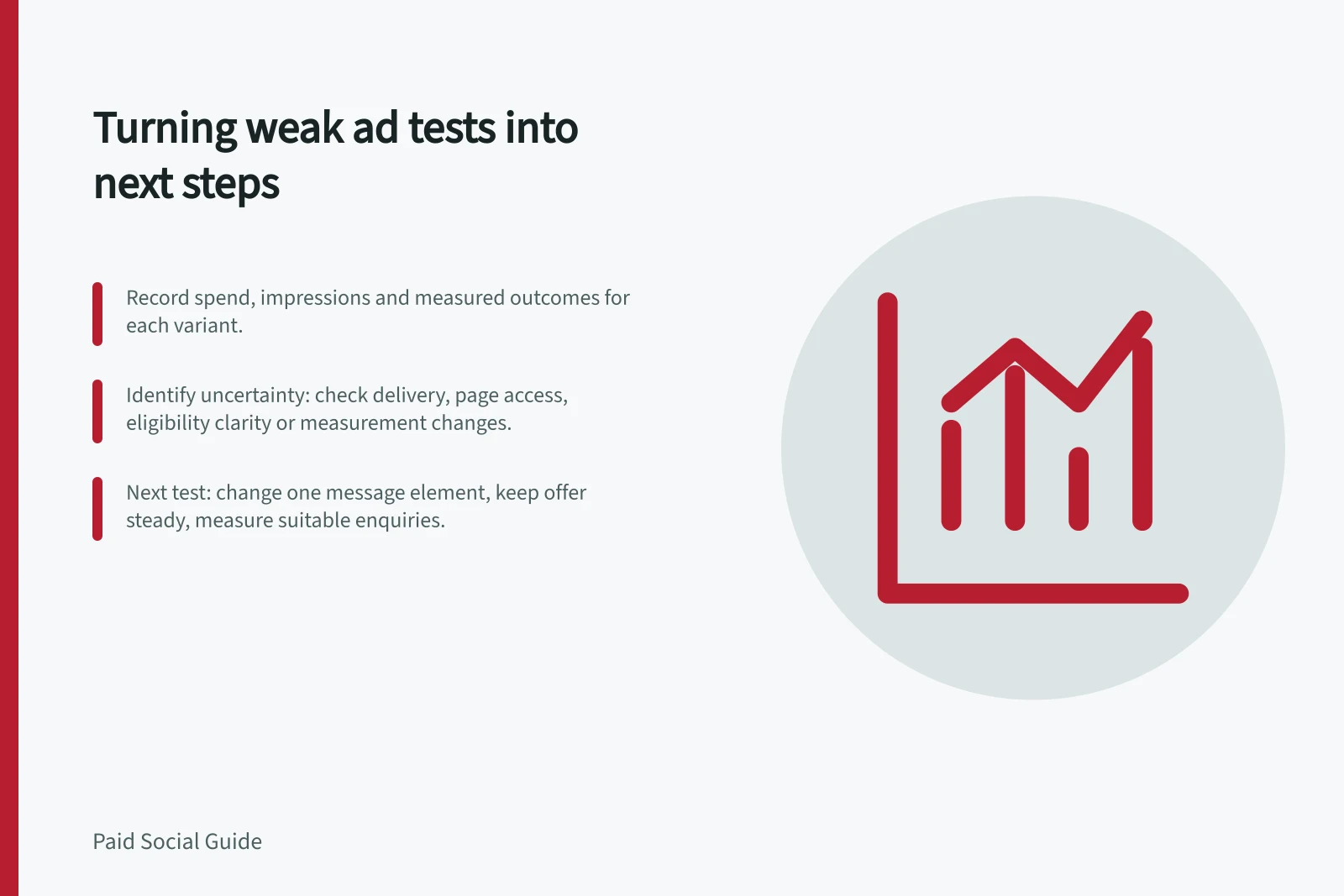
Keep the original question, variants, dates, audience, offer and chosen measure together. Record spend and impressions for each variant.
Few outcomes after little delivery say little about the message. A higher observed rate is not a proven winner when the comparison is inconclusive.
TikTok can report that no winning ad group was found at its stated 90% confidence level.
Platform labels concern the selected test metric, which may differ from the business outcome.
Key Metrics from a Weak Ad Test
- Test Duration
- Check if sufficient time was allocated for delivery
- Spend per Variant
- Ensure balanced budget distribution
- Impressions per Variant
- Assess delivery volume to support statistical confidence
- Confidence Level Reported
- TikTok typically uses 90% confidence; no winner found means inconclusive
Identify the uncertainty
| Observation | Possible next hypothesis | Check first |
|---|---|---|
| One variant received little delivery | The comparison did not expose that message enough to assess it | Eligibility, approval, allocation and test duration |
| Clicks occurred but useful visits were scarce | The destination may not have loaded or met the ad's promise | Page access and the first information shown |
| Visits occurred but few suitable enquiries followed | The message may not explain eligibility clearly | Enquiry records and stated conditions |
| Reported conversions fell across both variants | Measurement may have changed | Event diagnostics and confirmed business outcomes |
These are conditional hypotheses, not diagnoses. If measurement is broken, verify its repair before using conversion totals to choose creative. If the offer or destination changed during the run, record that break in the comparison.
Write the next testable question
Specify the audience and offer, the one message element to change, the defined outcome and the observed pattern behind the idea. Also state what result would make the team revise or reject it.
Suppose a hypothetical service ad about quick booking receives visits but few enquiries that meet a service-area rule. The next question could be whether stating the service area in the ad reduces unsuitable enquiries while retaining suitable ones.
A comparison would keep the offer and destination steady, change the eligibility message and review both total submissions and suitable enquiries. It predicts no result.
A brighter image would be a weaker response to that particular qualification problem unless there is evidence of a visual issue, such as an unreadable condition in the placement preview. Repeat a test when its question remains useful and more evidence is feasible.
Revise the hypothesis when delivery was adequate but the business outcome was weak. Stop creative comparisons while an unresolved destination, claim or measurement fault prevents a meaningful result. Record the observation, uncertainty, next change, measure and review point.