Conversion Tracking
Part of Social lead generation ads
Evaluating cost per qualified enquiry rather than raw lead cost
Define a qualified enquiry, calculate its cost and avoid comparisons distorted by incomplete review or changing rules.
Cost per qualified enquiry is ad spend divided by the number of enquiries that meet a defined business standard. It shows what a campaign spends to produce a request the team can reasonably pursue. Report the spend and counts beside the ratio so readers can see what it represents.
Define a qualified enquiry
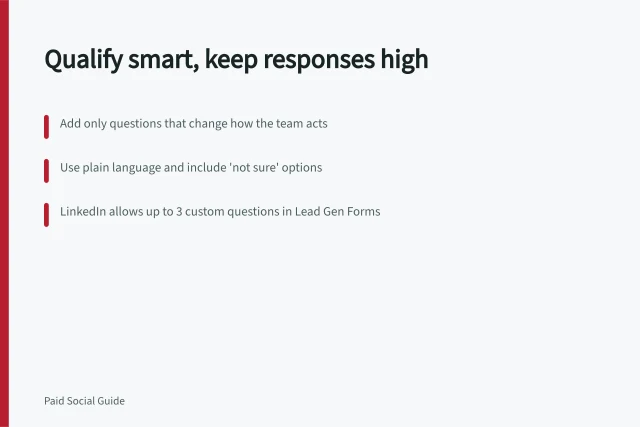
Set the rule before comparing campaigns. A service business might require a service it offers, an eligible location and usable contact details. Record why a reviewed enquiry fails the rule, and keep the rule consistent across the campaigns being compared.
Do not treat an unreviewed enquiry as unqualified. If the rule changes, mark the date and avoid presenting results from both definitions as a like-for-like trend. A form question that blocks ineligible people before submission also changes the population behind the reported qualification rate.
Calculate each stage
For a defined group of enquiries:
- Cost per submitted enquiry:
- spend ÷ submissions.
- Assessment coverage:
- reviewed submissions ÷ submissions.
- Qualification rate among reviewed submissions:
- qualified enquiries ÷ reviewed submissions.
- Cost per qualified enquiry:
- spend ÷ qualified enquiries.
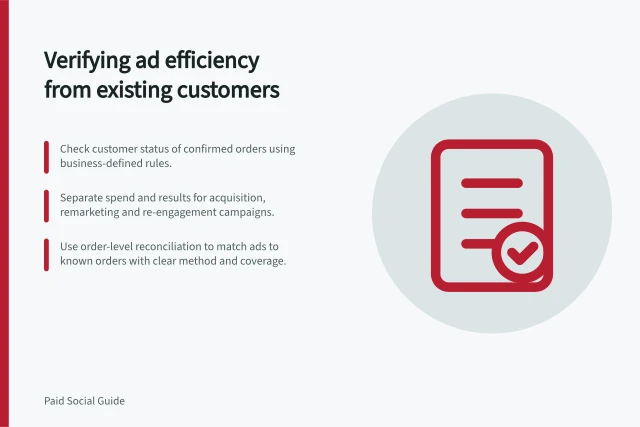
Use the spend attributable to the same campaigns and submission period as the enquiries counted. Allow comparable time for records to be reviewed. If there are no qualified enquiries, cost per qualified enquiry is undefined for that group; it is not zero.
Campaign A spends A$1,000, receives 100 submissions and has 10 qualified enquiries: A$10 per submission and A$100 per qualified enquiry. Campaign B spends A$1,000, receives 50 submissions and has 20 qualified enquiries: A$20 per submission and A$50 per qualified enquiry. The example shows why cheaper submissions need not mean cheaper qualified enquiries; it is not a campaign result.
Key Metrics for Qualified Enquiries
- Cost per Submitted Enquiry (Campaign A)
- A$10
- Cost per Submitted Enquiry (Campaign B)
- A$20
- Qualification Rate (Campaign A)
- 10%
- Qualification Rate (Campaign B)
- 40%
Steps to Calculate Cost per Qualified Enquiry
- Define a qualified enquiry using business criteria
- Track spend and submissions over the same period
- Review submissions and apply qualification rule consistently
- Calculate cost per qualified enquiryspend ÷ qualified enquiries
Check what the ratio hides
Compare groups with similar review time and the same qualification rule. Look for duplicates, missing records and enquiries sent to the wrong team. Keep “not yet assessed”, “not a fit” and “no response after contact attempts” separate: the last is a follow-up outcome, not necessarily an initial eligibility decision.
A lower cost per qualified enquiry helps only when the enquiries are comparable in value and the team can handle them. Where records allow, review later conversations, quotes and sales as well.
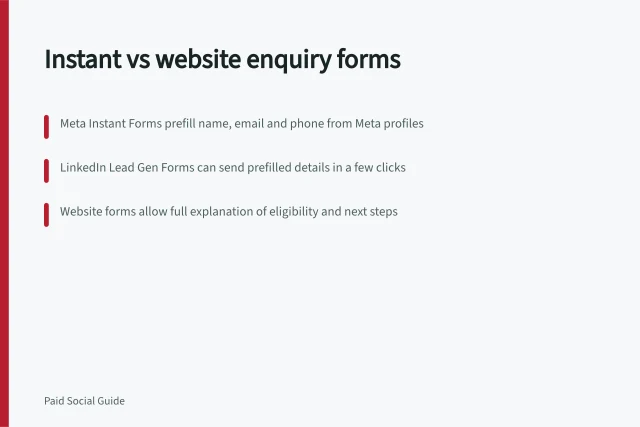
Platform lead counts capture submissions, while the working records establish which requests met the business rule. LinkedIn’s built-in reporting includes cost per lead and form fill rate; those figures alone do not supply an advertiser-specific qualified-enquiry count.