Account Structure
Social lead generation ads
Plan social lead generation ads around a clear enquiry, suitable form, reliable follow-up and qualified outcomes.
Social lead generation ads should make a clear offer, capture the details needed for a response and deliver each enquiry to someone who can act on it. Judge the campaign by suitable enquiries and later outcomes, as well as form submissions.
Choose platforms deliberately
Start by checking whether the people you want to reach use the platform and whether its audience, advertising options and lead tools match the campaign goal. business.gov.au recommends considering your target customers, what you want social media to achieve and the time and resources available to manage each channel.
Research where competitors are active, but treat that as a prompt to assess fit rather than a reason to copy their choices. business.gov.au advises that using one or two channels well can be better than spreading limited time and effort across many platforms.
Turn the offer into a clear ad action before building the form: the person should know what they will receive or what response they can expect. LinkedIn’s specifications allow an offer headline of up to 60 characters, optional offer detail of up to 160 characters and a call-to-action of up to 20 characters, so prepare concise wording that keeps the promise clear.
Setting up a social lead generation campaign: key steps
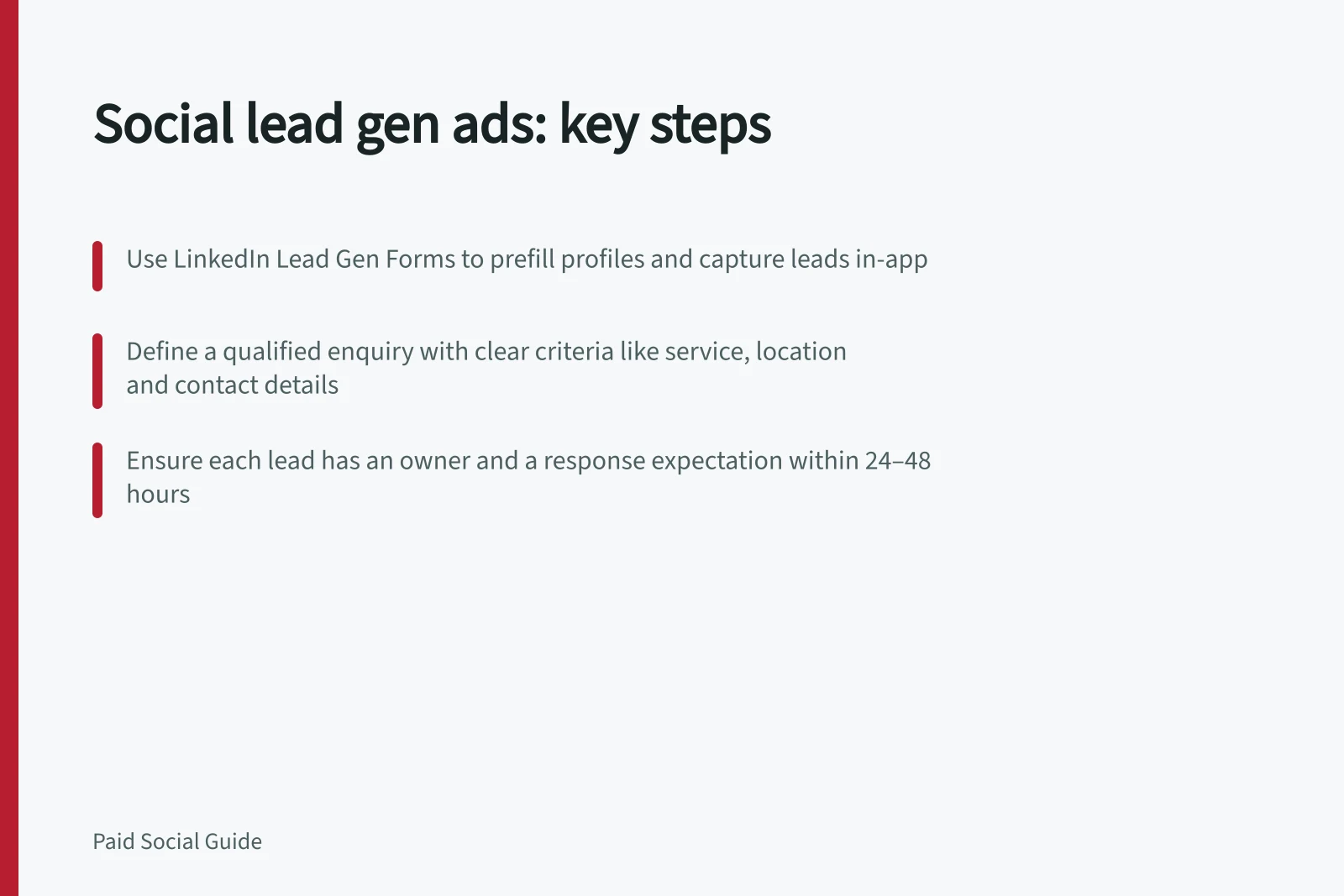
- Choose the right platformAssess if your target audience uses LinkedIn or TikTok, and whether their lead tools match your goal. Use business.gov.au’s guidance on channel selection.
- Define a clear offerCreate a concise ad with a headline (≤60 chars), detail (≤160 chars), and CTA (≤20 chars) that matches the form and sets expectations.
- Select the enquiry capture methodUse in-app forms (LinkedIn Lead Gen Forms or TikTok Instant Forms) for simplicity, or website forms for complex services requiring qualification.
- Design proportionate questionsLimit custom questions to those needed for immediate next steps—avoid asking for non-essential details upfront.
- Ensure reliable handoffAssign each lead to an owner and backup, confirm delivery path (CRM or Campaign Manager), and test a full submission cycle.
- Measure qualified outcomesTrack spend, submissions, contactable leads, qualified leads, and sales. Define 'qualified' clearly—e.g., service request in eligible area with valid contact info.
Start with the request
Decide what a person is asking for: a quote, consultation, demonstration or answer. State where the service is available, any important eligibility limits and what happens after submission.
The ad and form should describe the same offer. Ask for a detail only when it helps the team decide what to do next.
Choose a place to capture the enquiry
An in-app form lets someone submit without visiting a website. LinkedIn Lead Gen Forms can prefill profile details and make submissions available through Campaign Manager or a CRM integration. TikTok offers both Instant Forms and forms on an advertiser’s website.
A website form gives the advertiser space to explain a complex service or use an existing qualification flow. It also requires a usable page and reliable form delivery. TikTok’s guidance requires a TikTok Pixel for optimisation of its website lead campaigns.
Choose the route according to what the person needs to understand before enquiring and what the team needs to know before responding. Where both routes are viable, compare them using the same offer and qualification rule.
For a LinkedIn Lead Gen Form, make the post-submission step part of the offer plan. LinkedIn allows a confirmation message of up to 300 characters; use it to reinforce what the person requested and set an expectation for the next contact, consistent with the ad.
For TikTok website campaigns, TikTok recommends optimising for a minimum of three event types. Its examples include view content, contact, lead and complete registration; select events that represent meaningful steps in the journey, rather than treating every page visit as an enquiry.
Pros and cons of in-app vs website forms for lead generation
- In-app forms (LinkedIn/TikTok Instant Forms)Pros: Faster completion, profile prefilled (LinkedIn), higher conversion rates. Cons: Less space for explanation, limited customisation.
- Website formsPros: More room for detailed service descriptions, can integrate with existing qualification flows. Cons: Higher drop-off risk, requires functional page and reliable delivery.
Keep questions proportionate
A service area or requested service may change who responds. Questions that do not change the next action can wait until follow-up.
LinkedIn’s published specifications list up to three optional custom questions. TikTok offers several custom question types. Check the available controls in the relevant account before designing a conditional form.
Make the handoff reliable
Give each new enquiry an owner and a backup. Decide where submissions arrive, how repeat submissions are handled and what status records the outcome. Before launch, check a permitted sample submission through the complete route, including its answers, source and assigned owner. Set a response expectation the team can meet.
LinkedIn says leads can be downloaded from Campaign Manager or sent through an integration with a marketing automation or CRM tool, giving the campaign team a choice of delivery path to check during its end-to-end test.
Pre-launch checklist for social lead generation ads in Australia
- Confirm platform compliance with APPsEnsure notification of collection is provided at or before data collection, including ATO, ABN, and privacy policy details
- Test end-to-end submissionSubmit a sample lead through all stages: ad → form → delivery → assignment → follow-up
- Verify CRM or system integrationCheck that leads are delivered to the correct team member and stored with proper status tracking
- Review spam complianceAvoid misleading claims and ensure opt-out options; comply with ACMA’s anti-spam rules
Measure useful outcomes
Record spend, submissions, contactable enquiries, qualified enquiries and later sales outcomes separately. Define a qualified enquiry before comparing campaigns—for example, one requesting an offered service in an eligible area with usable contact details. Review why enquiries fail that rule before adding fields or changing the ad.
For Australian campaigns, entities covered by the Australian Privacy Principles must take reasonable steps to notify people of relevant collection matters or ensure they are aware of them. Notification should generally happen at or before collection, or as soon as practicable afterwards if that is not practicable.
OAIC guidance says these include the organisation’s identity and contact details, why information is collected, the consequences of not providing it, usual disclosures and relevant privacy-policy information.
Use platform reporting to see whether the campaign is producing engagement as well as submissions. LinkedIn recommends tracking cost per lead, lead-form fill rate and the number of leads from professional audience segments; review these alongside the team’s contactability and qualification records to spot where usable enquiries are coming from.
Key performance metrics for Australian social lead generation campaigns
- Cost per lead
- Track via LinkedIn Campaign Manager or TikTok Ads Manager
- Qualified leads
- Define criteria (e.g., eligible service area, valid contact details) before measuring
- Conversion to sale
- Track from lead to closed deal; benchmark against industry averages
In this guide
- Comparing instant forms with website enquiry formsCompare in-app and website enquiry forms by buyer context, qualification needs, delivery and qualified outcomes.
- Adding qualification questions without losing every responseChoose qualification questions that change the next action, fit platform limits and help produce usable enquiries.
- Routing social ad leads while they are still relevantSet a clear route from social lead form to an owner, verify delivery and keep unassigned enquiries visible.
- Evaluating cost per qualified enquiry rather than raw lead costDefine a qualified enquiry, calculate its cost and avoid comparisons distorted by incomplete review or changing rules.