Audience Targeting
Retargeting through social advertising
Social retargeting can return an eligible visitor to a product they considered, but an observed visit is not permission to infer identity, purchase intent or a …
Social retargeting can return an eligible visitor to a product they considered. Pixel-based targeting involving sensitive information requires careful review of consent and notification obligations.
Build the campaign around a defined objective, audience window and appropriate exclusions. Retargeting means showing ads to people who have previously interacted with your business, including website visitors on Facebook and Instagram.
Separate useful signals
Companion articles cover separating product viewers from abandoned checkouts and suppressing customers after a resolved purchase. Those audience decisions are outside this overview.
Audience options, retention settings and exclusions can change by account and platform. Confirm current settings in the campaign interface; do not reuse an old “maximum days” rule from a previous campaign.
Facebook and Instagram retargeting can show ads to people who have interacted with your business, including website visitors. Define the interaction relevant to the campaign, then check that the matching audience source is available in your account.
Use first-party data responsibly. Consider whether your notices explain how information is collected and used for advertising.
Retargeting Audience Sources on Meta Platforms (Facebook & Instagram)
- Website VisitorTracked via Meta Pixel; eligible for retargeting after interaction with landing page or product page.
- Cart AbandonerUser added item to cart but did not complete purchase; ideal for recovery campaigns.
- App UserIndividuals who interacted with your mobile app, including in-app actions.
- Engaged Content ViewerPeople who liked, commented on or shared content on your Facebook or Instagram page.
Plan creative for social feeds
Facebook, Instagram and LinkedIn offer social advertising options based on demographics, interests and behaviours. Choose the platform and audience settings that fit the campaign objective, then make the ad's next step clear.
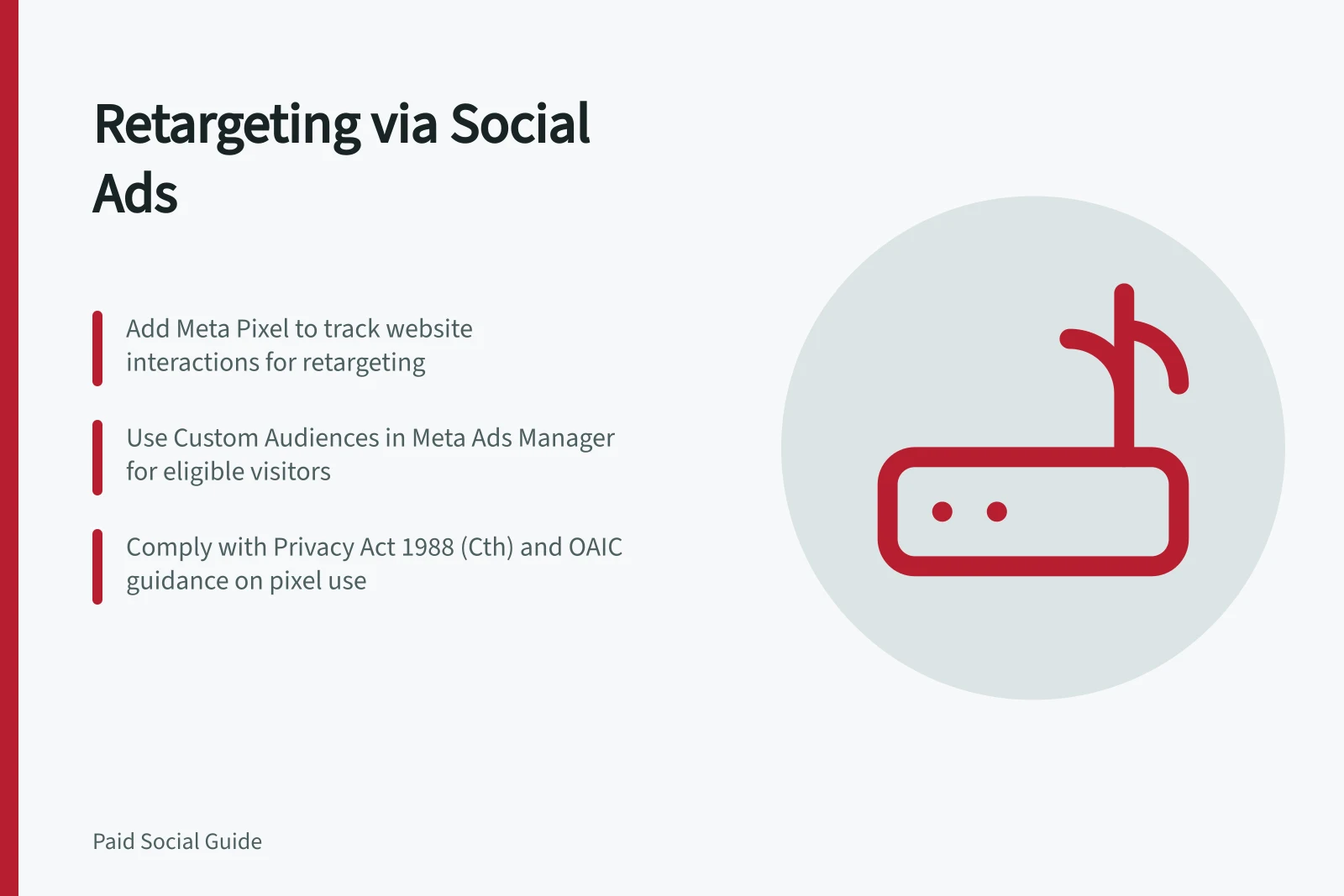
For website retargeting on Meta, add the Meta Pixel, formerly called the Facebook Pixel, to your website to track user interactions. Use website interactions to build a Custom Audience in Meta Ads Manager and select that audience for ads.
Facebook retargeting can include people who visited a website or interacted with an app. Interactions can range from a Facebook like to a website action such as adding an item to a cart.
Choose a campaign objective, then use the platform’s current advertising interface to create a website audience from eligible interactions with your business. Check that the audience source and settings are available for your account, and prepare the creative and destination page.
Review the audience, campaign settings and ad before publishing. Once live, monitor delivery and results, then adjust the campaign as needed.
Creative can refer to a product someone previously viewed or show related items, without suggesting you know why they visited. Localised content and seasonal promotions, such as summer offers or end-of-financial-year campaigns, are other ways to make an ad relevant to Australian audiences.
If an offer or message is specific to a location, set delivery to the intended area; for example, use Sydney or Melbourne when the offer is intended for those areas. Keep the creative consistent with the actual offer and destination, so the ad does not promise something the landing page cannot provide.
Setting Up a Facebook/Instagram Retargeting Campaign in Australia
- Install Meta PixelAdd the Meta Pixel code to your website to track user interactions such as page views and add-to-cart events.
- Define AudienceCreate a Custom Audience in Meta Ads Manager based on website visits or other interactions within a set timeframe.
- Choose Campaign ObjectiveSelect objectives like 'Conversions' or 'Traffic' aligned with your goal—e.g., recovering abandoned carts.
- Design CreativeUse localised messaging (e.g., summer sales, end-of-financial-year offers) and ensure consistency between ad and landing page.
- Set Geographic DeliveryRestrict delivery to target areas (e.g., Sydney or Melbourne) if the offer is location-specific.
- Review & LaunchVerify audience settings, privacy compliance, and creative accuracy before publishing.
Review delivery and privacy
Choosing a retargeting window from the purchase cycle is covered in a companion article. Monitor delivery through reach, frequency, spend and incremental action where measurement allows.
A missing purchase event does not prove the person did not buy elsewhere. A view-through conversion alone is weak evidence of incremental impact; compare with a holdout or another suitable design when stakes justify it.
Detecting saturation in a small audience is covered by its own article. For Australian organisations handling personal information, review pixel use, notices and consent against the Privacy Act 1988 (Cth) and OAIC guidance.
The OAIC has published guidance on tracking pixels and subsequently confirmed advertising technology as a regulatory priority. The organisation deploying a tracking pixel remains responsible for its use.
Review the pixel, any cookies and the information collected. Retargeting based on online behaviour may constitute use of personal information for direct marketing, so consider the applicable notice and consent obligations.
Recent determinations found health service providers contravened the Australian Privacy Principles by collecting sensitive information without consent, failing to notify, and using or disclosing sensitive information for direct marketing without consent. Keep ad copy and audience settings from implying sensitive information.
The determinations involved Medmate Australia Pty Ltd and Monash IVF Pty Ltd. They found contraventions of APP 3.3, APP 5.1 and APP 7.1 relating to sensitive information, notification and direct marketing.
In this guide
- Choosing a retargeting window from the purchase cycleA retargeting window is the time a past action remains eligible for a reminder. Choose it from the buyer's decision period, not from the longest setting a platform …
- Separating product viewers from abandoned checkoutsA product view and a started checkout are different steps. Combining them into one retargeting audience can lead to a message that assumes a visitor almost bought …
- Suppressing customers after a resolved purchaseAn acquisition reminder shown after a purchase can waste spend and confuse a customer. Use a completed-purchase event to remove observed buyers from that reminder …
- Detecting retargeting saturation in a small audienceWhen a retargeting audience is small, the same people can receive many ads quickly. A high frequency figure is a warning to investigate, not proof of irritation or …