Audience Targeting
Part of Retargeting through social advertising
Suppressing customers after a resolved purchase
An acquisition reminder shown after a purchase can waste spend and confuse a customer. Use a completed-purchase event to remove observed buyers from that reminder …
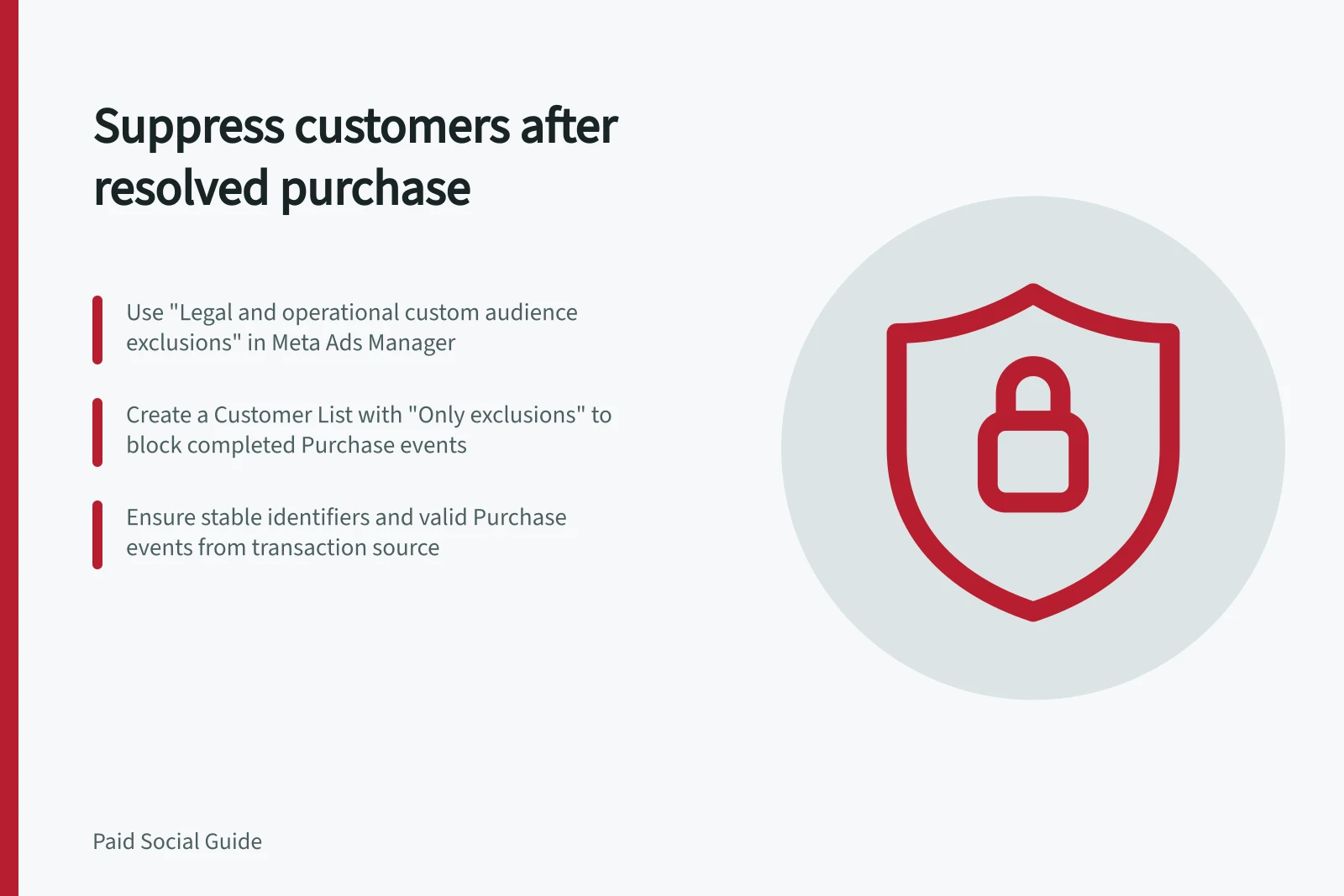
An acquisition reminder shown after a resolved purchase can waste spend and confuse a customer. In Meta Ads Manager, use a custom audience exclusion at the ad set’s Audience Controls; the named control is “Legal and operational custom audience exclusions”. A completed Purchase event can identify observed buyers, but the system cannot suppress a purchase it never received.
To build a list-based exclusion, go to Audiences, create a Customer List custom audience and select “Only exclusions” if that suits the suppression policy. At the ad set, open Audience Controls > Legal and operational custom audience exclusions and add the audience. “Only exclusions” cannot later be changed to an inclusion audience or used to create a lookalike.
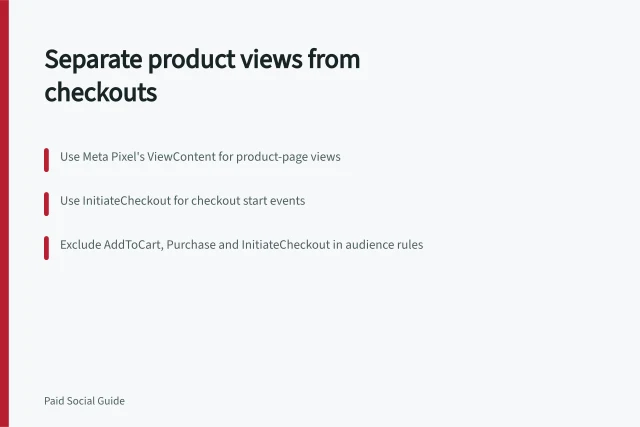
Where purchase events feed the audience, use the Purchase event received through pixel/CAPI reporting. Keep a stable identifier across browser and server reports to avoid duplicate reporting. Meta’s exclusion-only audiences can suppress groups across Facebook, Instagram and the Meta Audience Network.
Check the transaction source before launch: it must send a valid Purchase event and a stable identifier. Treat only orders marked completed as resolved; update the customer-list input if a cancellation or refund changes that status. An offline sale can drive suppression only if it reaches that input.
Choose whether the exclusion covers the purchased product, its category or all acquisition messages; a subscription renewal may need a different rule from a one-off item. Keep the exclusion active for as long as you intend to suppress those customers, and review the audience’s last refresh date.
Test with a fictional completed order. Confirm it reaches the intended audience after the platform’s processing delay, then inspect any overlapping campaign that could still show the same offer. Do not treat the absence of a purchase signal as proof that someone has not bought through another store or device.
Check the audience and exclusion controls in the account. If customer data or pixels are used, follow the organisation’s privacy review and opt-out process; OAIC guidance addresses tracking pixels and privacy obligations. Report suppression coverage as a data-quality limit, not as proof of perfect post-purchase silence.
Key stats for effective post-purchase suppression
- Suppression coverage
- Data-quality limit — not proof of perfect post-purchase silence
- Meta platform coverage
- Facebook, Instagram and Meta Audience Network