Account Reviews
Paid social campaign strategy for Australian advertisers
Plan Australian paid social campaigns around a business outcome, clear offer, suitable objective, affordable test and useful evidence.
Start with the business outcome, the offer and the evidence that will tell you whether advertising helped. Then choose the campaign role, objective and placements. Clicks can show interest without producing suitable enquiries or worthwhile orders.
Set the business outcome and limit
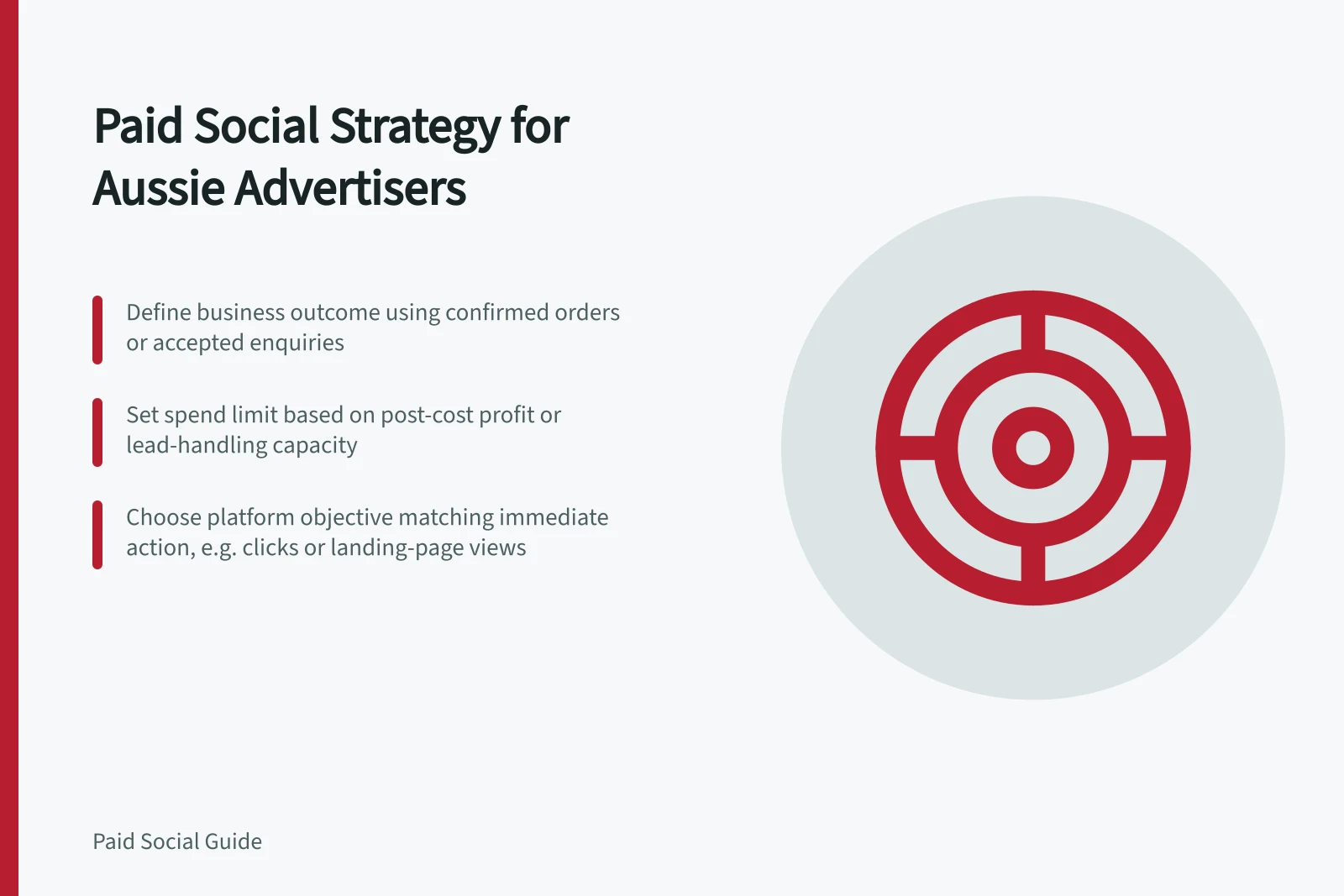
An online retailer might seek first purchases from new customers. A service business might seek enquiries it can serve in specified Australian locations. Define the outcome in business records, such as confirmed orders or accepted enquiries, and decide who will review it.
Set a spend limit the business can afford while it learns. For sales, estimate what remains after the costs assigned to each order. For leads, define a suitable enquiry and check that the team can handle the expected follow-up. These are planning inputs, not predicted advertising results.
| Decision | Question to answer |
|---|---|
| Customer | Who can use the offer, and what does the business know about them? |
| Action | Should they learn, enquire or buy? |
| Offer | Are the price, eligibility and next step clear? |
| Evidence | Which business record will show a useful result? |
| Limit | What result would prompt a change or pause? |
Define the platform conversion
Before launch, name the action the platform should count as a conversion and check that it represents the business outcome. LinkedIn gives examples including submitting a lead, downloading content, signing up for a free trial, making a purchase or registering for an event. Its conversion tracking measures actions after someone clicks on or views an ad, so interpret that signal alongside the business record that confirms the result.
Give each campaign a job
Prospecting introduces an offer to eligible people who may be unfamiliar with it. Retargeting can address a relevant next question after a permitted, observable interaction. Separate those roles when they need different messages, budgets or decisions. A recorded visit does not prove purchase intent, and an audience list cannot identify everyone who has encountered the business.
Choose a platform objective that fits the immediate action, then inspect its optimisation setting. A traffic objective can pursue visits; visits alone are not sales.
TikTok, for example, offers landing-page views under its Traffic objective, but its documented setup defaults to clicks unless that setting is changed. LinkedIn says its chosen objective shapes later format, feature and bid choices. Check the options available in the account before committing creative or spend.
Choose placements after that. Check whether each eligible placement can carry the essential message and whether the destination works on a phone. If a format cannot communicate a material condition clearly, revise the creative or placement choice.
Platform objectives vs. business outcomes: What each should deliver
- Objective: Prospecting (new audience)Goal: Introduce offer to people unfamiliar with brand; platform tracks interest (e.g., clicks, views). Business outcome: First purchase from new customer.
- Objective: Retargeting (engaged users)Goal: Address next question after interaction (e.g., download, visit); platform tracks follow-up actions. Business outcome: Enquiry accepted in target Australian location.
- Objective: Traffic (visits)Goal: Drive visits to landing page; platform counts visits (not conversions). Business outcome: Purchase confirmed or enquiry recorded.
Make the promise and destination agree
The ad and destination should describe the same product or service, relevant price or eligibility conditions, and next step. Check that someone in the target area can complete the promised action and that enquiries reach a team able to respond.
The ACCC accepts reports about possible misleading or false claims and uses them to inform its education, compliance and enforcement work. It can require businesses to back up claims about their products or services, and may investigate and take action if a business misleads.
Australian advertising compliance and tracking essentials
- ACCC enforcement authority
- Can investigate and take action on misleading claims
- OAIC privacy guidance
- Applies to tracking pixels and digital data collection
- Meta Ads best practice
- Use conversion tracking to align platform events with business outcomes
- Digital expense accountability
- Required for GST and ATO reporting purposes
Review a bounded test
Give the initial campaign one main question, a spend limit and a review date. Record the offer, objective, audience, placements and destination so changes can be interpreted.
Read platform figures alongside business records. Impressions and clicks describe delivery and response.
Attributed conversions depend on tracking and attribution settings; they need not equal confirmed orders or accepted enquiries. At review, compare the business result with the question and limit set before launch.
Continue if the evidence supports the intended outcome and the test remains within the limit. Change an element if the evidence points to a specific break.
Pause if the limit is reached without enough evidence of a worthwhile result. Pause if a material issue needs resolving. Record the decision and reason.
Include a privacy review when website tracking is involved. The OAIC has guidance on tracking pixels and privacy obligations; check the requirements that apply to the organisation and data involved. Sending events through another connection does not settle those questions.
In this guide
- Choosing a paid social objective before selecting placementsChoose a paid social objective from the action you need, check the optimisation goal, then assess eligible placements and the customer journey.
- Separating prospecting from retargeting campaignsDecide when prospecting and retargeting need separate campaigns, define their roles and check audience, overlap and reporting limits.
- When paid social is unlikely to solve a weak offerSpot offer problems that more paid social spend cannot fix, then check claims, eligibility, fulfilment and commercial value.