
Conversion Tracking
Social conversion tracking
Social conversion tracking should describe a real business event once, with the right value and the right permission state.
Social conversion tracking should describe a real business event once, with the right value and the right permission state. More events do not automatically mean better measurement.
A browser pixel and a server connection may both report the same purchase. Without a shared identifier and platform-specific deduplication, the dashboard can count or optimise against the wrong signal.
A useful comparison separates the business record from each platform's view of the event. Treat platform conversion totals as reporting signals, not additive customer counts, when more than one platform may claim the same outcome.
Business Record vs Platform Conversion Totals
- Business Record
- Single, verified event (e.g. completed purchase with order ID)
- Platform Conversion Totals
- Reporting signals; may double-count same event across platforms
Choose social channels against business goals
Social media can serve different purposes: attracting customers, building loyalty and trust, interacting with customers, promoting or selling products and services, and driving website traffic. Decide which purpose a campaign is intended to serve before judging its conversion results; a channel's value depends on the business goal being assessed.
Platform choice should reflect the intended audience. Consider whether your target customers use the platform and what you know about their age, gender and interests; market research can help establish where they are. Not every platform will suit every business or customer group.
Competitors can provide another point of comparison: review which platforms they use and whether those channels could work for your business. Social platforms may recommend content based on what users already engage with, creating an opportunity to reach people who interact with competitors.
Include the time and resources needed to manage each channel in the decision. business.gov.au advises that it is better to use one or two social channels well than to use many poorly. A tracking plan should match the channels the business can realistically maintain.
Add measurement feasibility to the choice: identify the business event, a platform-supported route for reporting it and a consent-aware way to maintain that route. A channel that reaches the target audience still needs a usable event signal for conversion reporting.
Define the conversion before wiring it
Pick the event that matters: a completed purchase, qualified lead or other verified outcome. Name the system of record and the moment the event becomes final. A button click is not a purchase, and a thank-you page view may repeat when someone reloads the page. Map every platform event back to this business definition.
Attribution is the framework for assigning credit for a conversion to a source, campaign or ad. Use platform reports to compare activity within that platform, and use order or CRM records to assess business outcomes.
Compare the same defined event and reporting period, and avoid adding platform totals together when more than one platform may claim credit for the same conversion. Keep each platform's reported view distinct from the business record when assessing results.
For a purchase, specify order ID, value, currency, event time and any refund or cancellation handling. TikTok's event documentation says some value-based functions require both Value and Currency. Check each platform's parameter rules; do not infer that the same payload works everywhere.
Defining a Conversion Before Implementation
- Identify the business eventCompleted purchase, qualified lead, or other verified outcome
- Define the system of recordOrder or CRM system where event is finalised
- Specify key parametersOrder ID, value, currency, event time, refund/cancellation handling
- Match platform requirementsEnsure value and currency are included where required
Keep commercial outcomes distinct from supporting actions
An event can be easy to measure without representing the result the business wants. TikTok's Event Builder can configure button clicks and visits to URLs containing specified keywords, and can suggest events based on webpage buttons and elements. Treat these as measurement options, not proof that a purchase or qualified lead has occurred.
When reviewing event choices, distinguish actions that represent commercial intent from lower-intent activity. Keep genuine leads or purchases distinct from actions such as generic page views or newsletter sign-ups, rather than treating them as equal-weight conversions.
If Google Ads is also part of the measurement picture, its named decision measures include cost per lead, Maximise Conversions, Target CPA and Target ROAS. Keep those measures distinct from the definition and reporting of social-platform conversions.
Connect browser and server deliberately
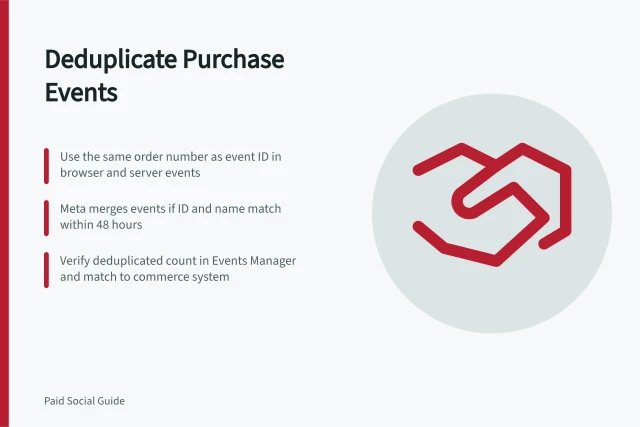
Use both sources where they add coverage, but decide whether they report the same event or different events. TikTok requires a common event_id for overlapping Pixel and Events API events to deduplicate them, and describes distinct timing rules.
That is a TikTok implementation detail, not a guarantee about other platforms. Generate an event ID at the business action and pass the same ID through both routes, so overlapping reports resolve to one event.
Across platforms, first decide whether browser and server reports represent the same action or separate events. If they overlap, check that platform's deduplication requirements rather than assuming TikTok's identifier and timing rules apply elsewhere.
Check / Expected finding
- One business purchase
- One intended conversion after deduplication
- Browser unavailable
- Eligible server event follows the platform and privacy rules
- Repeated page load
- No new purchase event from the same order
- Refund or cancellation
- Reporting treatment is documented and reconciled
Connecting Browser and Server Events Deliberately
- Generate event ID at business actionUse a unique ID for each real event (e.g. purchase)
- Pass same ID through both routesBrowser pixel and server-side API use identical event_id
- Check platform deduplication rulesTikTok requires common event_id; others may differ
- Handle edge casesRefunds, cancellations, repeated page loads – ensure no duplicate reporting
Check platform tools against the measurement plan
Platform event-setup tools can help configure measurement, but they are implementation aids: the business still decides which event represents the intended outcome. TikTok, for example, offers Event Builder and custom code as different ways to configure events and parameters.
The social channel examples include Facebook, Instagram and YouTube. For Facebook or Instagram ads, Meta Pixel tracks website activity after someone clicks, and Meta Conversions API provides a server-side route; TikTok uses TikTok Pixel and Events API.
Google Ads conversion tracking is another named product, but it is not a universal social tracking tool. Match each platform's measurement route to the channel and event in the plan.
Platform-Specific Conversion Tracking Options in Australia
- Facebook & Instagram
- Meta Pixel (browser), Conversions API (server)
- TikTok
- TikTok Pixel (browser), Events API (server)
- Google Ads
- Conversion tracking via tag or API
- Australian Privacy Compliance
- OAIC guidelines apply to all tracking pixels
Respect the data boundary
Review consent logic across browser and server routes together. If site consent settings change, retest accepted and declined states and document any reporting discontinuity.
The OAIC publishes guidance titled “Tracking pixels and privacy obligations”. Use that guidance when assessing pixel-based tracking, and review browser and server routes together against the site's consent design.
Reconcile platform event counts with the order or CRM system by day, but expect differences from attribution, identity and processing. Investigate sudden changes in event rate, value or currency before using the data for optimisation. Maintain an event specification and change log so a later team can distinguish campaign performance from a tracking release.
In this guide
- Testing browser and server-side conversion events togetherWhen the browser pixel and server integration report the same conversion, test them as a pair.
- Deduplicating purchase events from two data sourcesDeduplication solves a specific problem: the same purchase reaches an ad platform from both browser and server and must count once.
- Handling changes to a website's consent settingsA consent-banner change can alter conversion data even when the campaign and website sales are stable.