Account Structure
Part of Paid social budgets and campaign pacing
Avoiding repeated budget changes before enough evidence accumulates
Set protective triggers and review dates so repeated paid social budget edits do not obscure delivery and business evidence.
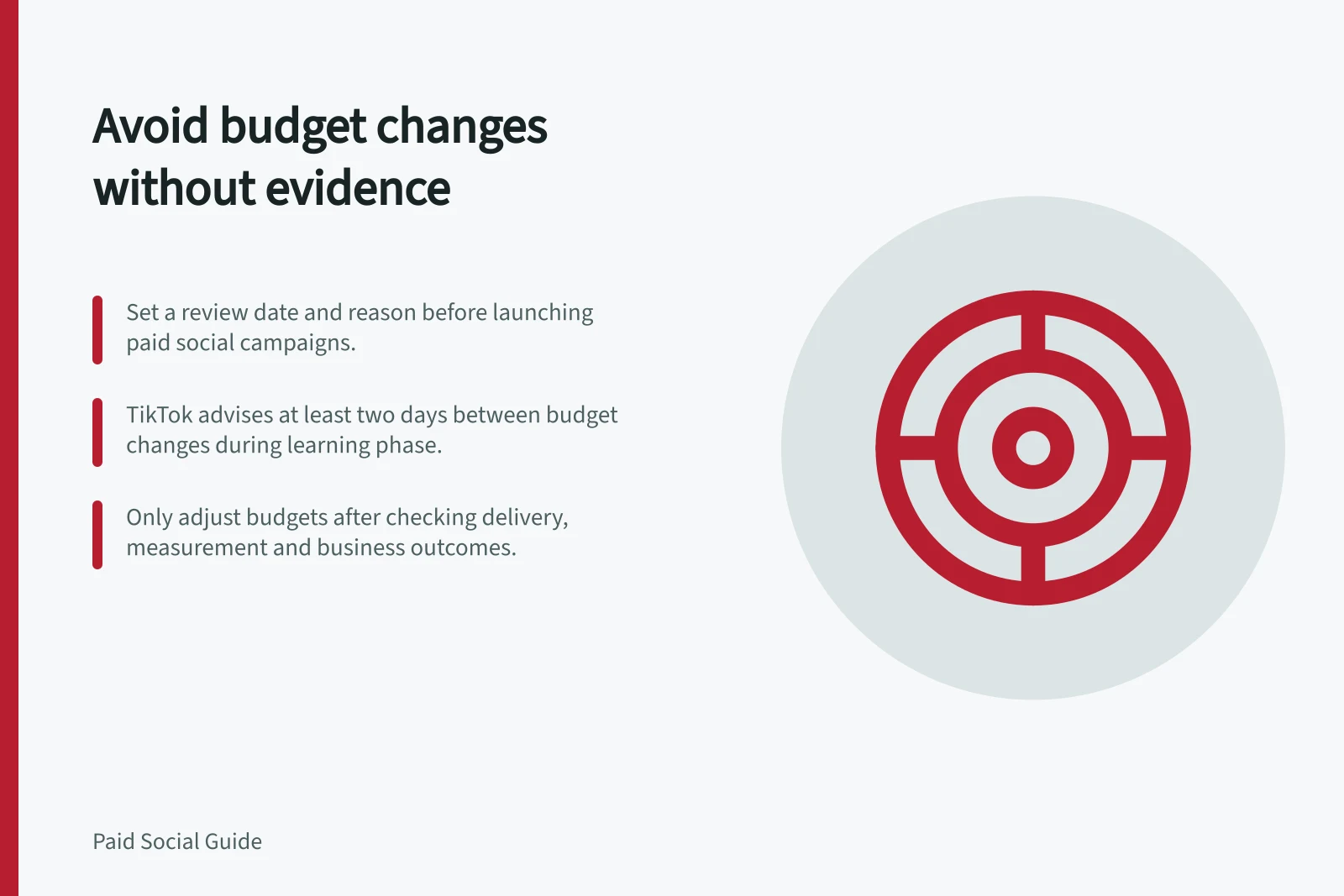
Set a review date and a reason for changing a paid social budget before launch. Check promptly for genuine faults or unauthorised spending. Otherwise keep the campaign stable long enough to judge delivery and useful business outcomes. Repeated edits change the conditions being measured.
Separate urgent corrections from planned reviews
A rejected ad, inaccurate offer, broken destination or spend-control error may need immediate action. A low conversion count soon after launch calls for a different check: the outcome may be rare, delayed or measured incorrectly. Inspect status and measurement before treating the budget as the cause.
- Protective trigger:pause or correct a fault or unauthorised spend when found.
- Planned review trigger:assess spend and business outcomes at an agreed point, with the remaining uncertainty visible.
No universal number of conversions makes a budget decision safe. The useful amount of evidence depends on the outcome, its normal delay and what the business can afford while learning.
Apply platform timing guidance narrowly
TikTok's budget guidance advises leaving at least two days between targeting, bid or budget changes. For conversion campaigns, it also advises avoiding those edits during the learning phase. Its separate budget page gives guidance on increase size by learning status.
These are platform recommendations, not a guarantee that two days will supply enough business evidence. A protective correction should not wait for a routine review date.
For TikTok campaign budget optimisation, the documented lower-funnel learning phase and suggested review metrics sit at campaign level. Spend may concentrate in a few ad groups. A quiet group under that shared budget is not by itself a reason to edit the campaign; first assess the campaign-level result and whether the allocation serves the business purpose.
TikTok budget guidance summary
- Minimum interval between changes
- 2 days
- Learning phase advice
- Avoid edits during learning phase for conversion campaigns
- Budget increase guidance
- Adjust based on learning status (as per platform documentation)
Keep changes interpretable
For a proposed edit, record the problem, supporting evidence, setting to change, expected effect, previous budget, cumulative spend and next review date. If budget, bid, audience and creative all change together, later results cannot readily show which edit mattered.
| At review | Decision to consider |
|---|---|
| Delivery is blocked | Fix the displayed or technical cause |
| Spend is approved but outcomes are sparse | Continue to the planned review if affordable, or pause near the limit |
| A persistent delivery constraint is supported by evidence | Change that constraint and record it |
| Useful outcomes remain unacceptable | Revise or stop; additional budget alone is not a remedy |
When a decision must be made with limited evidence, record that uncertainty. A pause or modest reversible change may be reasonable, but it is still a decision under uncertainty.